
Biggest Steel Companies: How to Choose a Steel Supplier
Biggest Steel Companies: How to Choose a Reliable Steel Supplier
The biggest steel companies are not always the best choice for every project. A large production capacity helps with supply, but buyers also need consistent material quality, clear test reports, dependable delivery, and technical support. Rahim Steel is one of Bangladesh’s established steel producers, with operations that began in 1958 and products that include steel billets, deformed bars, and MS plates.
This article explains what separates a dependable steel company from an ordinary supplier. It focuses on steel billets, their role in rolling mills and rebar production, and the practical checks buyers should make before ordering.
Biggest Steel Companies: What Buyers Should Compare
When reviewing the biggest steel companies, do not judge them only by factory size or annual output. Those numbers matter, but they do not tell you whether a particular batch of steel will meet your project requirements.
A reliable supplier should be able to show:
- The standard its products follow, such as ISO 6935-2:2016
- Chemical composition reports for each batch
- Mechanical test results
- Dimensional specifications
- Material certificates
- Clear delivery and packaging terms
- A contact point for technical questions
Rahim Steel states that it produces billets under ISO 9001-certified production and follows ISO 6935-2:2016. The company also says every batch undergoes chemical analysis, dimensional verification, and mechanical testing, and provides material certificates.
Why billet quality matters
Steel billets are the starting material for many rolled products. A rolling mill heats a billet and passes it through rollers to produce TMT bars, rods, angles, channels, and structural sections. If the billet is inconsistent, the finished product can be inconsistent too.
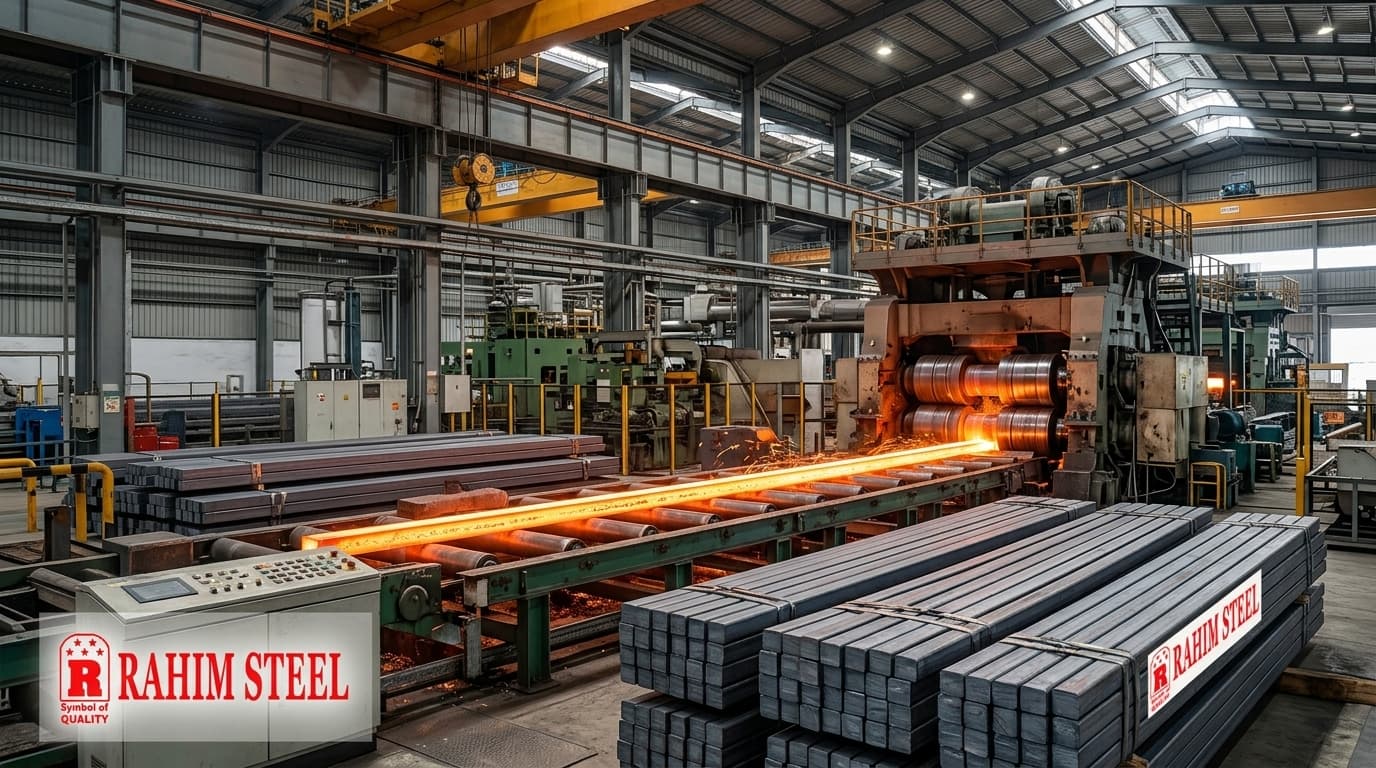
Rahim Steel Billets are made for rolling mills and rebar production. The company produces them through melting, refining, ladle treatment, continuous casting, controlled cooling, cutting, and inspection. The aim is to maintain uniform dimensions, clean surfaces, and controlled chemical composition.
Important billet characteristics include:
- Correct carbon, manganese, silicon, phosphorus, and sulfur levels
- Uniform cross-section and length
- Low internal stress after cooling
- Clean surface condition
- Minimal internal defects
- Consistent strength and ductility
For a rolling mill, these qualities reduce rejection rates and improve production efficiency. For a construction buyer, they support more predictable rebar performance.
Steel Billets, TMT Bars, and Structural Products
Rahim Steel Billets are used as the primary raw material for TMT bars, rods, and structural steel products. They are also suitable for angles, channels, rods, sections, automotive components, machinery parts, and foundation steel for construction and industrial projects.
The company’s stated typical billet chemistry is:
| Property | Typical Range |
| Carbon © | 0.25–0.35% |
| Manganese (Mn) | 0.40–1.20% |
| Silicon (Si) | 0.03–0.50% |
| Phosphorus (P) | 0.045% maximum |
| Sulfur (S) | 0.050% maximum |
| Grade | Mild / medium carbon steel |
| Standard | ISO 6935-2:2016; ISO 9001 certified production |
These values affect how the steel behaves during rolling and in the finished product. Carbon influences strength and hardness. Manganese supports strength and helps control impurities. Silicon assists deoxidation. Phosphorus and sulfur are kept low because excessive amounts can reduce toughness and workability.
Rahim Steel produces billets in square or rectangular sections, commonly from 100 mm × 100 mm to 150 mm × 150 mm. Standard lengths are typically 4–12 meters. The company says it surface-inspects billets and bundles them for shipment after cutting and finishing.
From billet to finished steel
Rahim Steel’s production process includes several controlled stages:
- Melting and refining: Steel is melted in an induction furnace with controlled alloying and low impurity levels.
- Ladle treatment and deoxidation: The chemical composition is adjusted to reach the required carbon, manganese, and other element levels.
- Continuous casting: Molten steel is cast into billets with standard square or rectangular sections.
- Cooling and solidification: Uniform cooling helps reduce internal stress and supports a fine-grain structure.
- Cutting and finishing: Billets are cut to standard lengths, inspected, and bundled.
- Quality control: Each batch is checked through chemical analysis, dimensional verification, and mechanical testing.
This process is important because steel is not just about strength. A bar may meet a strength target but still perform poorly if its ductility, surface condition, or internal structure is poor. Controlled production reduces those risks.
Rahim Steel’s Experience and Product Range
Rahim Steel’s history gives buyers useful context. The company began as National Foundry in Shyampur, Dhaka, in 1958, producing basic iron and cast products. In 1968, it launched a re-rolling mill to manufacture 40-grade deformed bars. Diamond Steel Products Co. Pvt. Ltd. followed in 1976, and Rahim Steel Mills Co. (Pvt.) Ltd. was established in Kachpur, Sonargaon, in 1983.
The company later expanded into steel production, shipbreaking, energy, and plate manufacturing. It began producing mild steel commercial plates in 2003 and received Germanischer Lloyd GL-A certification for shipbuilding-grade plates in 2004.
Today, Rahim Steel supplies billets, deformed bars, hot-rolled plates, and shaft round bars. Its products are used in construction, infrastructure, fabrication, shipbuilding, machinery, and general engineering.
Products and applications
Rahim Steel’s product range includes:
- Steel billets: Raw material for rolling mills, TMT bars, rods, and structural sections
- Deformed bars: Reinforcement steel for concrete construction
- MS plates: Structural frames, bridges, flyovers, machinery bases, storage tanks, and fabrication work
- Shaft round bars: Engineering and machinery applications
For construction projects, the main concern is usually rebar quality. For fabricators, plate flatness, surface finish, and weldability matter more. For rolling mills, billet consistency is the priority. A good supplier should understand which requirement applies to your purchase.
How to Make a Better Purchase Decision
Before choosing among the biggest steel companies, prepare a short requirement sheet. Write down the product type, required standard, dimensions, quantity, delivery location, and test documents you need. Then ask each supplier to confirm these points in writing.
For billets, request chemical composition and dimensional reports. For rebar, ask for mechanical test results and the applicable grade. For plates, check thickness tolerance, surface condition, and relevant mechanical properties. This approach makes supplier comparisons fair and reduces the chance of later quality disputes.
Rahim Steel’s stated quality process, product certifications, and long operating history make it a practical option for buyers who need billets, rebar, or structural steel in Bangladesh. Its contact and quotation channels are available for buyers who need current specifications, availability, or commercial terms.
The best supplier isn't simply the one with the biggest name. It is the one that can prove material quality, meet your required specifications, deliver on schedule, and respond when you need technical help.
Questions and Answers
Q: What are the biggest steel companies known for?
A: Large steel companies are usually known for production capacity, product range, and ability to supply large projects. However, buyers should also check quality certification, batch testing, delivery reliability, and technical support. Rahim Steel combines billet production, deformed bars, MS plates, and shaft round bars under one product range.
Q: What is a steel billet?
A: A steel billet is a semi-finished steel product with a square or rectangular cross-section. It is heated and rolled into finished products such as TMT bars, rods, angles, channels, and structural sections. Rahim Steel Billets are produced for rolling mills and rebar manufacturing.
Q: Why are billets important for TMT bar quality?
A: TMT bars are rolled from billets. If the billet has uneven chemistry, cracks, or internal defects, those problems can affect the finished bar. Rahim Steel controls chemical composition, billet size, cooling, and inspection to support consistent rolling performance and mechanical properties.
Q: What standards should buyers ask about?
A: Ask for the applicable product standard, such as ISO 6935-2:2016, and request the material certificate for the specific batch. Rahim Steel states that its billets follow ISO 6935-2:2016 and are produced under ISO 9001-certified production.
Q: What chemical tests matter most?
A: Carbon, manganese, silicon, phosphorus, and sulfur are the main checks for Rahim Steel Billets. The stated typical ranges are carbon 0.25–0.35%, manganese 0.40–1.20%, silicon 0.03–0.50%, phosphorus up to 0.045%, and sulfur up to 0.050%.
Q: What sizes are Rahim Steel Billets available in?
A: Rahim Steel produces billets in standard square or rectangular sections, typically from 100 mm × 100 mm to 150 mm × 150 mm. Standard lengths are usually 4–12 meters. Buyers should confirm the exact section and length needed for their mill.
Q: Can Rahim Steel Billets be used for structural steel?
A: Yes. The company identifies its billets as raw material for TMT bars, reinforcement steel, structural steel production, angles, channels, rods, and sections. They can also be used in engineering and industrial applications that need controlled steel input.
Q: How does Rahim Steel test its products?
A: The company says each batch undergoes chemical analysis, dimensional verification, and mechanical testing. It also provides material certificates with its products.
Q: How can buyers request a quotation?
A: Buyers can request pricing or product details through Rahim Steel’s contact page: Request Quote or Contact Sales.
Need Steel Experts?
We have our own team of civil and architectural professionals ready to assist you. Just share your requirements with our experts — we’ll be happy to serve you with the right solutions, exactly as you need.
Contact Our Experts