
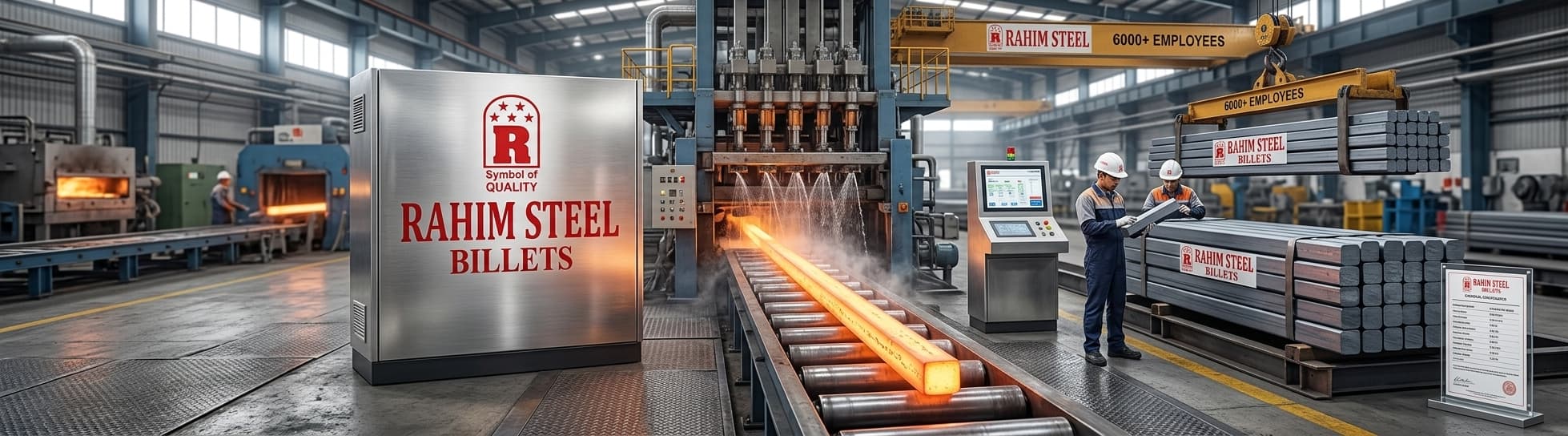
Driving Innovation in Steel Industry: Rahim Steel Billets Excellence
Driving Innovation in the Steel Industry: The Unmatched Quality of Rahim Steel Billets
Building high-rise structures, industrial complexes, and civil infrastructure demands high-performance foundational materials. Within the rapidly growing steel industry, the quality of finished TMT rebars and structural steel relies directly on the purity and strength of the raw steel billets used in production. Rahim Steel Mills has continuously set benchmark standards across the modern steel industry by producing ISO-certified steel billets and high-ductility rebar solutions that ensure structural longevity and safety.
Premium Rahim Steel Billets: Essential Raw Material for High-Grade Construction
Rahim Steel Billets serve as the primary raw material for manufacturing high-quality TMT bars, structural angles, channels, and engineering sections. Produced via continuous casting from refined molten steel, these billets feature uniform dimensions, minimal internal stress, and controlled chemical composition.
Key Specifications & Chemical Composition
Standard & Certification: ISO 6935-2:2016 and ISO 9001 certified production.
Steel Grade: Mild and Medium Carbon Steel.
Carbon (C): $0.25\% - 0.35\%$
Manganese (Mn): $0.40\% - 1.20\%$
Silicon (Si): $0.03\% - 0.50\%$
Phosphorus (P): $\le 0.045\%$
Sulfur (S): $\le 0.050\%$
The Step-by-Step Manufacturing Process
Melting & Refining: Steel is melted in induction furnaces with tight control over impurity levels.
Ladle Treatment: Adjust carbon and manganese ratios to exact specifications.
Continuous Casting: Molten steel is cast into square or rectangular cross-sections (100 mm x 100 mm to 150 mm x 150 mm).
Controlled Cooling: Uniform cooling minimizes internal stress and develops a fine-grain crystalline structure.
Cutting & Inspection: Rahim Steel cuts billets to standard lengths (4 to 12 meters) and subjects them to chemical and mechanical quality checks.
Advanced TMT Processing: Why RSM B420DWR Rebars Lead in Earthquake Safety
Beyond raw billets, Rahim Steel converts high-grade steel into finished RSM B420DWR rebars using online Thermo-Mechanical Treatment (TMT). The process combines high surface strength with a flexible inner core:
Quenching: High-pressure water jets rapidly quench the hot-rolled bar, hardening the outer surface into martensite.
Self-Tempering: Core heat flows outward, tempering the exterior into Tempered Martensite while the core stays hot and austenitic.
Atmospheric Cooling: On the cooling bed, the core transforms into a ductile ferrite-pearlite structure, yielding superior ductility and bendability.
Primary Applications
Heavy RCC Foundations: Footings, columns, beams, and shear walls.
Seismic Structures: Engineered specifically for earthquake-prone regions due to high uniform elongation ($8\%\text{ EMF}$).
Major Infrastructure Projects: Trusted by public institutions including PWD, LGED, RHD, DPHE, EED, RAJUK, WASA, City Corporations, and MES.
A Legacy of Excellence: Rahim Steel’s Impact on the Regional Steel Industry
Tracing its origin back to 1958 as National Foundry in Shyampur, Dhaka, Rahim Steel has grown into an industrial enterprise spanning over 100 acres and employing over 6,000 people. As Bangladesh's only MS plate mill, the company has played a key role in expanding the domestic steel industry's capabilities.
Key Historical Milestones
1958: Established as National Foundry, manufacturing basic cast iron products.
1968: Launched Bangladesh's first re-rolling mill to produce 40-grade deformed bars.
1983-1984: Expanded into Kachpur, Sonargaon, establishing a steel production plant.
2003: Started production of mild steel commercial plates, supplying $20\%$ of national demand.
2004: Achieved Germanischer Lloyd (GL-A) international certification for shipbuilding-grade plates.
How to Procurement & Expert Foundation Recommendation
Sourcing Rahim Steel Products
Consult Structural Engineers: Calculate required tonnage, rebar grades, or billet specifications based on construction designs.
Contact Sales Divisions: Contact Rahim Steel Mills sales representatives or certified regional distributors for formal price quotes.
Verify Material Certificates: Ensure every delivered batch includes official testing certificates verifying yield strength and chemical composition.
Expert Foundation Recommendation
Every long-lasting structure relies on a well-engineered foundation. Underground structural elements like footings, pile caps, and grade beams handle the highest compression and shear stresses. Using high-quality raw materials from refined steel billets to certified B420DWR TMT rebars guarantees maximum seismic resistance, superior concrete bonding, and decades of structural safety. Always prioritize certified steel for your foundation work to secure your building's long-term future.
Product Questions & Answers
Q: What are the main applications of Rahim Steel Billets?
A: Rahim Steel Billets serve as the primary raw material for rolling mills producing TMT rebars, structural channels, angles, rods, automotive parts, and heavy engineering components.
Q: Why is B420DWR rebar preferred over 500-grade rebar for earthquake zones?
A: B420DWR offers higher ductility and higher uniform elongation , allowing structures to absorb dynamic energy during seismic events without sudden brittle fracture.
Q: Are Rahim Steel products verified by quality control testing?
A: Yes, all billets and rebars undergo chemical analysis, dimensional verification, and mechanical testing to meet ISO, ASTM, and BDS standards, complete with material compliance certificates.
Need Steel Experts?
We have our own team of civil and architectural professionals ready to assist you. Just share your requirements with our experts — we’ll be happy to serve you with the right solutions, exactly as you need.
Contact Our Experts