
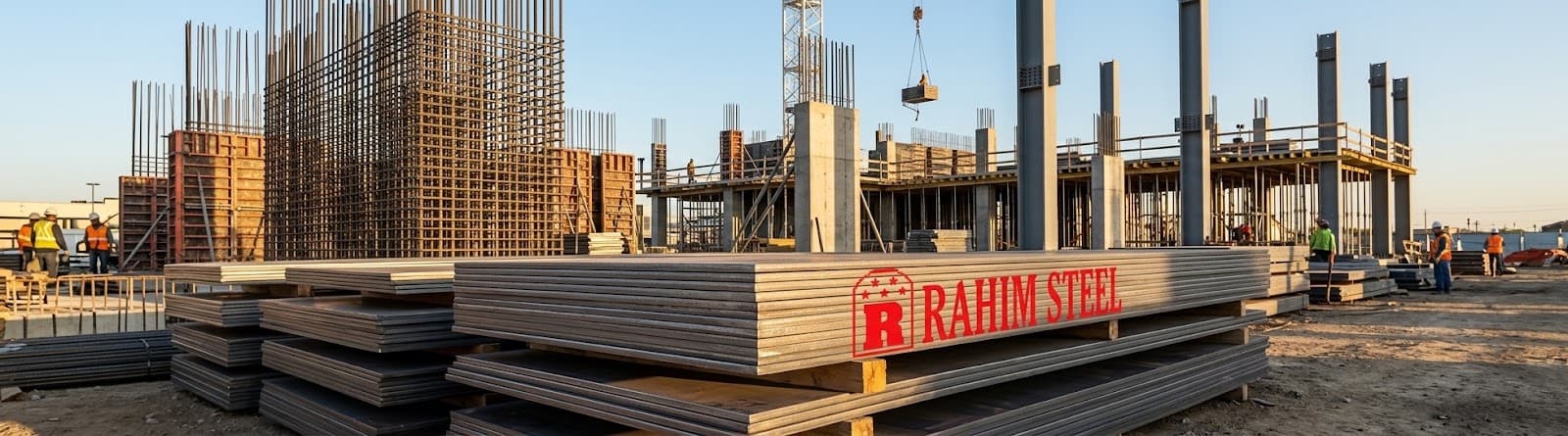
MS Plate in Construction: Price, Quality & How to Choose the Right One
From Foundation to Structural Strength: Why Selecting the Right MS Plate Matters
The longevity and safety of any structure begin at its foundation. Subsurface foundations not only bear and distribute the dead and live loads of an entire structure, but they also define its overall stability. Therefore, at the earliest stage of any construction project, it is vital to determine precisely what types of steel materials should be used and where.
Beyond standard building construction, steel plates are indispensable across industrial, commercial, and engineering fabrication applications. However, acquiring an MS (Mild Steel) plate involves much more than simply checking market prices. Factors such as steel grade, thickness, dimensions, intended engineering application, batch quantity, and official quality documentation must all be thoroughly evaluated before making an investment.
In this context, Rahim Steel’s MS PLATE COMMERCIAL GR. 40 / A-36 stands out as a dedicated product choice engineered to fulfill stringent project specifications.
The Vital Role of MS Plates in Building and Structural Work
From foundational elements to superstructure framing, steel utilization depends heavily on structural design and specific load-bearing requirements. Mild steel plates are custom-selected based on structural, fabrication, and heavy-duty industrial needs.
Before deploying any steel plate on-site, the most critical question is: Does it comply with your project’s technical specifications? Engineers and procurement officers must maintain absolute clarity regarding plate grade, thickness tolerance, surface dimensions, and mechanical properties.
Foundations & Base Plates: Where and how steel plates are incorporated into foundation columns, footings, or base connection assemblies must strictly adhere to the structural drawings and guidance provided by certified structural engineers.
Fabrication & Framing: For fabrication, girders, gusset plates, and heavy machinery mounts, conforming to project design tolerances prevents failure under stress.
Why Material Selection Is Crucial
Using steel with mismatched specifications can cause severe bottlenecks during cutting, welding, fabrication, or installation, potentially compromising structural integrity.
Key verification checklist before procurement:
Required Grade: (e.g., ASTM A-36, Commercial Grade 40)
Accurate Thickness & Tolerances: Gauge consistency across the plate.
Length & Width: Customized to minimize cutting waste on-site.
Intended Application: Dynamic vs. static structural loading.
Batch Quantity: Consistent mechanical properties across large orders.
Mill Test Certificates (MTC): Traceability and quality compliance paperwork.
Manufacturer Background: Proven credibility and manufacturing heritage.
Professional Procurement Insight:
Quality procurement is not about finding the cheapest material on the market—it is about securing the right material specification that guarantees structural safety and long-term durability.
Why Choose Rahim Steel MS Plates?
A Proven Industrial Heritage
Rahim Steel Mills began its industrial journey in 1958 as the National Foundry in Shyampur, Dhaka. Over the decades, the company has transformed into a cornerstone of Bangladesh’s modern steel manufacturing sector:
1968: Rahim Steel commissioned Bangladesh’s very first re-rolling mill, pioneering the production of 40-grade deformed bars.
1976: Established Diamond Steel Products Co. Pvt. Ltd., broadening its engineering capabilities.
1983: Set up Rahim Steel Mills Co. (Pvt) Ltd. in Kachpur, Sonargaon, expanding into commercial shipbreaking and secondary steel manufacturing. Founder Chairman Mr. Abdur Rahim initiated Bangladesh's first professional shipbreaking operations to create a sustainable supply chain of quality raw materials for the domestic steel industry.
2003: Marked a transformative milestone by commencing commercial Mild Steel (MS) Plate production, eventually supplying up to 20% of national market demand.
Today, Rahim Steel is widely recognized as Bangladesh's dedicated MS plate mill, delivering raw materials and finished steel products to key infrastructure, commercial, and industrial developments.
Key Reasons to Consider Rahim Steel MS Plates:
Specific Technical Grading: The MS PLATE COMMERCIAL GR. 40 / A-36 provides a clear, reliable standard meeting commercial and structural engineering requirements.
Project-Tailored Availability: Plate dimensions, thicknesses, and order volumes can be aligned precisely with your bill of quantities (BOQ).
Six Decades of Expertise: A legacy spanning more than 65 years provides buyers with unmatched trust in material consistency and supply reliability.
Transparent Quality Documentation: Full access to technical specifications and compliance documentation directly from the mill.
Understanding MS Plate Prices in Bangladesh & How to Procure
When searching online for "MS plate price in Bangladesh", you will likely encounter varying rates. However, steel plate pricing cannot be assessed as a one-size-fits-all figure.
Steel prices naturally fluctuate based on:
Grade specifications (e.g., Commercial Grade vs. Structural Grade)
Plate thickness and customized dimension cutting
Total order volume/tonnage
Global scrap and billet prices, along with local market dynamics
Relying solely on generic internet price listings can lead to inaccurate budgeting. Obtaining a project-specific quotation directly from the manufacturer ensures both technical compatibility and financial clarity.
5-Step Guide to Streamlined MS Plate Procurement
Step 1 — Define Project Requirements: Clearly outline where the plates will be applied (e.g., base plates, industrial fabrication, framing) and calculate total tonnage needed.
Step 2 — Confirm Engineering Specifications: Consult your structural engineer or project manager to finalize required grade (e.g., Gr. 40 / A-36), plate thickness, and exact dimensional boundaries.
Step 3 — Review Technical Data: Evaluate Rahim Steel’s technical product datasheets and test parameters to ensure full design compliance.
Step 4 — Request a Current Quotation: Share your required dimensions, grade, and volume with Rahim Steel’s enterprise sales team to receive a current, tailored quotation.
Step 5 — Finalize Procurement: Validate delivery timelines, transport logistics, quality certificates, and payment terms before dispatching the order.
Conclusion
A durable and safe building is built on rigorous planning and sound engineering decisions. From foundation layout to overhead structural fabrication, choosing materials that precisely align with engineering codes is non-negotiable.
Rahim Steel’s deep-rooted industrial background from establishing the country's first re-rolling mill in 1968 to initiating modern commercial MS plate production in 2003 reflects decades of steelmaking expertise.
When budgeting for your next development, avoid relying on generalized online price figures. Specify your exact grade, thickness, and quantity requirements to secure an accurate, transparent commercial quotation. If your project demands MS PLATE COMMERCIAL GR. 40 / A-36, contact Rahim Steel’s representative sales team today to ensure your construction moves forward with certified strength.
Frequently Asked Questions (FAQ)
Q1: What are MS Plates typically used for?
A: MS (Mild Steel) plates are widely used in building base plates, bridge and flyover construction, heavy machinery fabrication, storage tanks, shipping structures, and commercial steel buildings.
Q2: What should I inspect before buying MS Plates?
A: You should check the steel grade, nominal thickness and tolerances, dimensions (length and width), surface finish, Mill Test Certificates (MTC), and the supplier's manufacturing track record.
Q3: Can MS Plates be used in building foundations?
A: Yes, MS plates are frequently utilized as base plates, anchor tie assemblies, and load-distribution plates in foundation systems. However, placement, thickness, and anchorage must be specified by a certified structural engineer.
Q4: Why do MS plate prices vary across suppliers?
A: Price differences reflect variation in steel raw material quality, manufacturing standards, yield strength, plate thickness precision, order quantity, and broader market commodity fluctuations.
Q5: How can I order Rahim Steel MS Plates?
A: Prepare your engineering drawings or bill of quantities (BOQ) with specific thicknesses and dimensions, then reach out directly to Rahim Steel’s corporate sales department to receive official availability dates and price quotations.
Need Steel Experts?
We have our own team of civil and architectural professionals ready to assist you. Just share your requirements with our experts — we’ll be happy to serve you with the right solutions, exactly as you need.
Contact Our Experts