
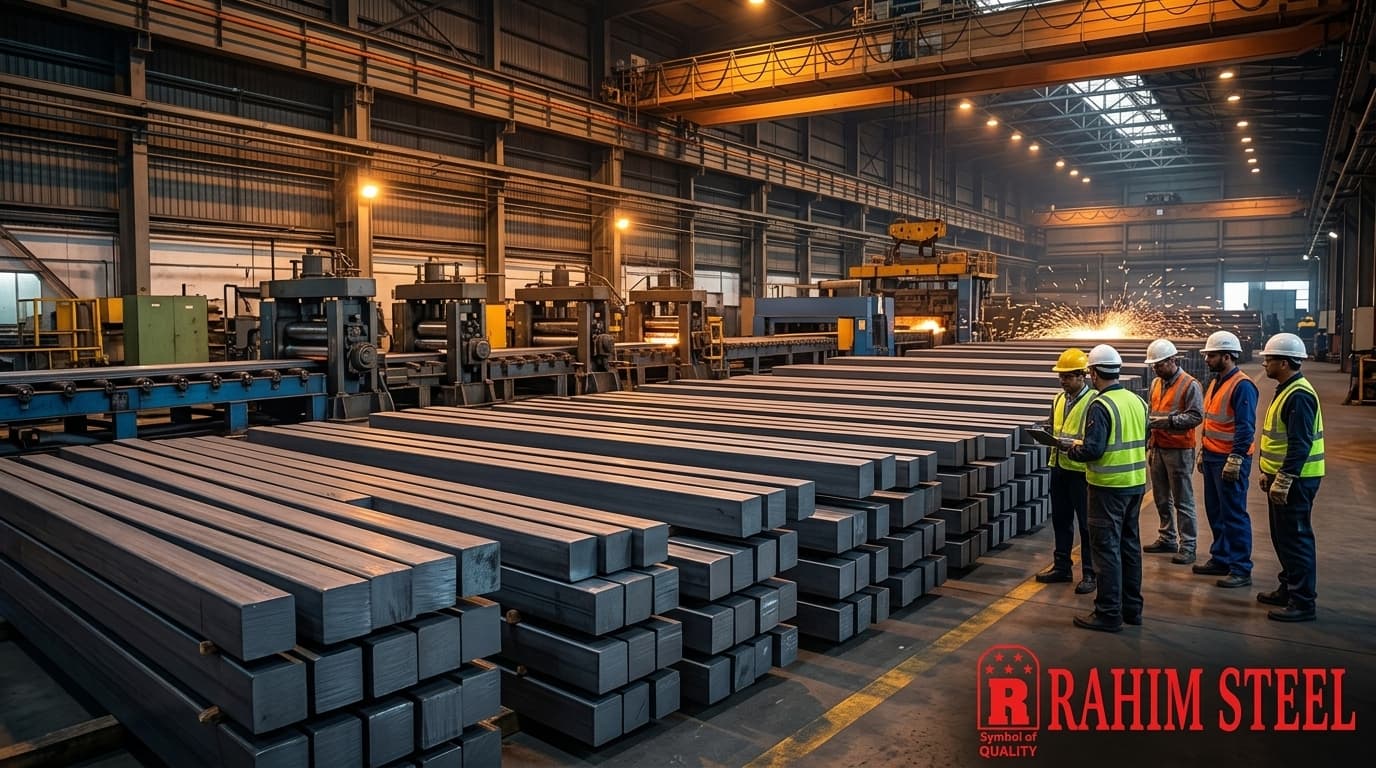
Rahim Steel Billets: A Trusted Choice for Rolling Mills in Bangladesh
Best Steel in Bangladesh: Why Rahim Steel Billets Are a Reliable Choice for Rolling Mills
For manufacturers, construction suppliers, and rolling mills, choosing the right billet is essential for producing consistent, high-strength steel products. Rahim Steel Billets are manufactured as a dependable raw material for TMT bars, reinforcement steel, rods, angles, channels, and other structural applications.
Rahim Steel Mills has a long-standing presence in Bangladesh’s steel sector and produces billets alongside deformed bars, plates, and other steel products. The company states that its production operations follow quality-management practices under ISO 9001 certification, and its reinforcement products align with BDS ISO 6935-2:2016 requirements.
Best Steel in Bangladesh for Quality Billet Supply
When people search for the best steel in Bangladesh, they usually want a product with reliable chemical composition, uniform dimensions, stable mechanical performance, and dependable quality control. These factors matter especially for rolling mills, where billet consistency directly affects the quality of the final rebar or structural section.
Rahim Steel Billets are designed for downstream processing. They are produced under controlled conditions to support consistent rolling performance, reduced internal defects, and improved finished-product quality. The billets are suitable as the primary raw material for:
TMT bars and reinforcement steel
Structural steel sections
MS rods and round bars
Angles, channels, and flat bars
Engineering and machinery components
Industrial and infrastructure projects
Rahim Steel also identifies billets as one of its core long-steel products. Testing and quality-control processes support its steel products and are designed to meet local and international specifications.
Rahim Steel Billets: Product Overview and Specifications
Rahim Steel Billets are manufactured from high-quality scrap or molten steel through a controlled melting, refining, and continuous-casting process. The objective is to produce a billet with clean surfaces, uniform cross-sections, controlled chemistry, and reliable mechanical properties for efficient rolling-mill operations.
Key specifications
Property
Rahim Steel Billets
Product type
Steel billets for rolling and rebar production
Typical grade
Mild to medium-carbon steel
Production process
Melting, refining, ladle treatment, continuous casting, controlled cooling, cutting, and inspection
Typical billet size
Approximately 100 mm × 100 mm to 150 mm × 150 mm square or rectangular sections
Typical length
Approximately 4–12 metres
Carbon (C)
0.25–0.35%
Manganese (Mn)
0.40–1.20%
Silicon (Si)
0.03–0.50%
Phosphorus (P)
Maximum 0.045%
Sulfur (S)
Maximum 0.050%
Quality assurance
Chemical analysis, dimensional verification, mechanical testing, and material certificates
The controlled use of carbon, manganese, silicon, phosphorus, and sulfur is important because these elements affect strength, ductility, weldability, rolling behaviour, and surface quality. A controlled composition helps rolling mills maintain repeatable production and reduce variation in finished bars or structural products.
Rahim Steel’s broader product range includes deformed bars that are hot-rolled from steel billets and processed using thermo-mechanical treatment. This makes billet quality an important starting point for producing consistent reinforcement steel.
Manufacturing Process and Quality Control
A high-quality billet is defined by more than its size. It depends on how the steel is melted, refined, cast, cooled, cut, and tested. Rahim Steel Billets follow a production route designed to support consistent chemical and physical characteristics.
1. Melting and refining
Steel is melted in an induction furnace, where alloying elements are controlled and impurities are minimized. This stage helps establish the required chemical foundation for the billet.
2. Ladle treatment and deoxidation
Before casting, the molten steel undergoes chemical adjustment. Operators fine-tune carbon, manganese, silicon, and other elements to achieve the desired grade and downstream rolling performance.
3. Continuous casting
The refined molten steel is continuously cast into standard square or rectangular billet sections. Continuous casting helps achieve uniform dimensions and supports efficient production for rolling-mill applications.
4. Controlled cooling and solidification
After casting, billets are cooled under controlled conditions. Uniform cooling reduces internal stress and supports a more consistent grain structure and hardness across the billet.
5. Cutting, surface inspection, and shipment
Billets are cut into standard lengths, inspected for surface condition, and prepared for delivery. This helps ensure that rolling mills receive material suitable for processing into rebars, rods, channels, angles, and other steel sections.
6. Batch-level quality checks
Quality control typically includes chemical analysis, dimensional checks, and mechanical testing. Rahim Steel highlights testing facilities and quality assurance across its steel product portfolio, including billets, bars, and MS plates.
Why Rahim Steel Is Considered Among the Best Steel in Bangladesh
Rahim Steel’s history reflects decades of involvement in Bangladesh’s industrial and steel-development journey. The company’s roots trace back to National Foundry in Shyampur, Dhaka, established in 1958. Over the following decades, the organization expanded into re-rolling, steel manufacturing, shipbreaking, commercial plates, and energy production.
Key milestones include:
1958: National Foundry was established in Shyampur, Dhaka.
1968: A re-rolling mill was launched to manufacture 40-grade deformed bars.
1976: Diamond Steel Products Co. Pvt. Ltd. was founded.
1983: Rahim Steel Mills Co. (Pvt.) Ltd. was established in Kachpur, Sonargaon.
1984: The company expanded its steel-plant capability, strengthening its position in Bangladesh’s steel industry.
2002: Rahim Energy, a 30 MW power plant, was inaugurated.
2003: Production of mild-steel commercial plates began.
2004: Germanischer Lloyd certification for shipbuilding-grade plates was awarded, according to the company history provided.
Today, Rahim Steel presents itself as a producer of billets, deformed bars, MS plates, and other steel products for construction and industrial use. It also emphasizes quality certification, testing facilities, and standards-based production.
Conclusion
Rahim Steel Billets offer a dependable foundation for manufacturers producing TMT bars, structural steel, rods, channels, angles, and other steel products. With controlled chemical composition, continuous-casting production, dimensional inspection, and quality testing, the billets support efficient rolling and consistent finished-product performance.
For a quotation, technical consultation, or billet availability, contact the Rahim Steel sales team and request the applicable material certificate, chemical analysis report, billet dimensions, and delivery details for your required application.
Frequently Asked Questions
What are Rahim Steel Billets used for?
Rahim Steel Billets are mainly used as raw material for manufacturing TMT bars, reinforcement steel, rods, structural sections, angles, channels, flat bars, and engineering components. They supply rolling mills and manufacturers that need consistent input material for steel production.
Why are steel billets important for TMT bar production?
Billets are the starting material for TMT bars. Their chemical composition, internal quality, dimensions, and surface condition influence the strength, ductility, rolling efficiency, and consistency of the finished rebar. Rahim Steel’s B420DWR rebars, for example, are produced by hot rolling steel billets followed by thermo-mechanical treatment.
What should buyers check before purchasing steel billets?
Buyers should review the billet’s chemical composition, size tolerance, surface condition, material certificate, quality-testing process, and suitability for the intended rolling or engineering application. Buyers should also confirm the required grade and dimensions with the supplier before ordering.
Does Rahim Steel provide quality assurance for its steel products?
Rahim Steel states that its products undergo quality control and that it maintains testing facilities and ISO 9001 certification. Buyers should request the relevant material certificate and batch documentation for their specific order.
Why choose Rahim Steel for billet supply?
Rahim Steel combines long experience in Bangladesh’s steel industry with billet, rebar, and plate production capabilities. For customers seeking the best steel in Bangladesh for rolling-mill or construction-related applications, Rahim Steel Billets offer a controlled, quality-focused input material backed by testing and certification practices.
Need Steel Experts?
We have our own team of civil and architectural professionals ready to assist you. Just share your requirements with our experts — we’ll be happy to serve you with the right solutions, exactly as you need.
Contact Our Experts