
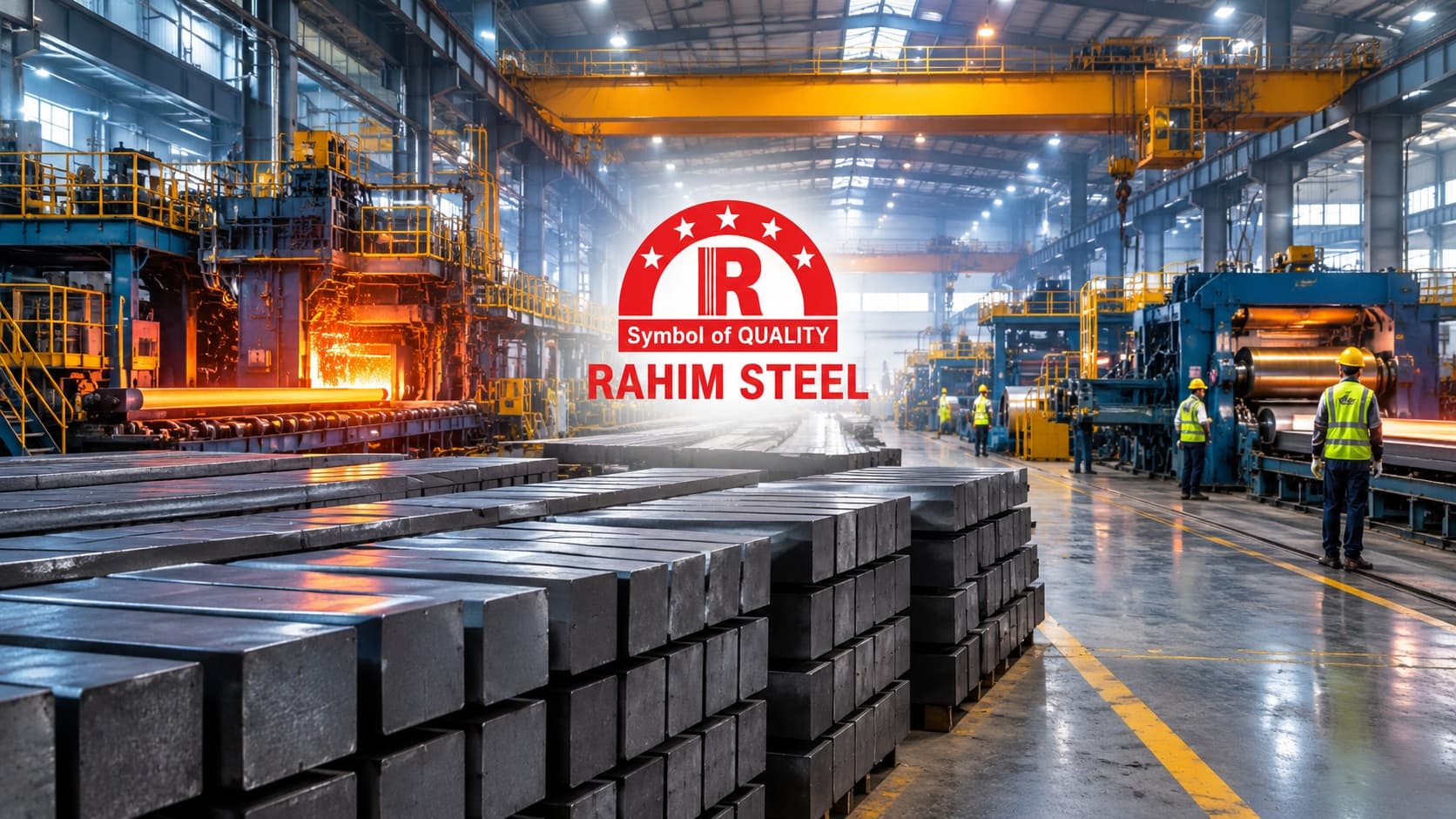
Rahim Steel Billets from One of Bangladesh’s Largest Steel Makers
One of the Largest Steel Manufacturers in Bangladesh: Rahim Steel Billets
Rahim Steel Mills is an established steel producer in Bangladesh, supplying billets and other steel products for construction, rolling mills, fabrication, and industrial applications. With a steel-making history dating back to 1958, Rahim Group’s published product range includes billets, deformed bars, MS hot-rolled plates, square bars, and related steel products.
Rahim Steel Billets are made for manufacturers that need dependable raw material for producing TMT bars, reinforcement steel, rods, angles, channels, and structural sections. The billets have a controlled chemical composition, uniform dimensions, and batch-level inspection to support steady downstream processing.
Rahim Steel’s Place in Bangladesh’s Steel Industry
Rahim Steel’s journey started in 1958, when Late Al-Haj Abdur Rahim established National Foundry in Shyampur, Dhaka. Over time, the company expanded from foundry operations into re-rolling, steel production, shipbreaking, commercial steel plates, ferro alloys, and energy-related businesses.
Important milestones in Rahim Steel’s history include:
- 1958: National Foundry was established in Shyampur, Dhaka.
- 1968: The first re-rolling mill began producing 40-grade deformed bars.
- 1976: Diamond Steel Products Company Private Limited was established.
- 1983: Rahim Steel Mill was established at Kachpur, Sonargaon, alongside the group’s entry into shipbreaking for metal-scrap sourcing.
- 1984: The group established what it describes as Bangladesh’s first steel plant in Kachpur.
- 2003: Rahim Steel began producing mild-steel commercial plates; the company says this plant met 20% of national demand for the product.
- 2004: Rahim Steel received Germanischer Lloyd approval for GL-A-grade hull structural steel plates for shipbuilding.
The phrase largest steel manufacturers in the BD is often used by customers looking for experienced companies with a broad product portfolio, quality systems, and dependable supply capability. Rahim Group describes its growth from one factory with 30 employees to a group with seven industries and approximately 6,000 employees.
Rahim Steel Billets for Rolling Mills and Rebar Production
Rahim Steel Billets are the core input material used in rolling mills to manufacture reinforcement bars, TMT bars, round bars, rods, angles, channels, and other steel sections. A billet with stable chemistry and a uniform cross-section helps rolling operations preserve consistent production conditions and achieve more reliable finished products.
Product overview
Rahim Steel Billets are produced from quality scrap or molten steel through melting, refining, ladle treatment, continuous casting, controlled cooling, and finishing. The production process is intended to produce clean billet surfaces, uniform dimensions, and controlled chemical properties.
The product is suitable for:
- Manufacturing TMT bars and reinforcement steel.
- Rolling mills producing structural steel products.
- Manufacturing rods, angles, channels, and sections.
- Automotive, machinery, and engineering applications.
- Construction and industrial projects requiring dependable steel inputs.
Rahim Group’s official product listing includes billets, 60-grade deformed bars, and commercial- and shipbuilding-grade hot-rolled plates.
Typical billet specifications
| Property | Typical specification |
| Product | Rahim Steel Billets |
| Steel grade | Mild to medium-carbon steel |
| Production route | Melting, refining, ladle treatment, continuous casting, controlled cooling, cutting, and inspection |
| Typical billet section | 100 mm × 100 mm to 150 mm × 150 mm |
| Typical length | 4–12 metres |
| Carbon © | 0.25–0.35% |
| Manganese (Mn) | 0.40–1.20% |
| Silicon (Si) | 0.03–0.50% |
| Phosphorus (P) | Maximum 0.045% |
| Sulfur (S) | Maximum 0.050% |
| Quality checks | Chemical analysis, dimensional verification, and mechanical testing |
Quality Control That Supports Better Steel Output
The quality of a finished rebar or structural section begins with the billet. Steel chemistry, internal soundness, size tolerance, cooling practice, and surface condition can all affect rolling performance. Rahim Steel Billets are manufactured under controlled conditions, so rolling mills can use more consistent raw material during production.
Rahim Steel Mills has stated that it operates an ISO 9001:2015-certified quality-management system. The company also highlights quality testing and standards-based manufacturing in its steel operations.
The billet-manufacturing process includes:
- Melting and refining: Steel is melted in an induction furnace, while alloying and impurity control are managed to achieve the target steel grade.
- Ladle treatment and deoxidation: Chemical composition is adjusted to maintain the required balance of carbon, manganese, silicon, and other elements.
- Continuous casting: Molten steel is cast into square or rectangular billet sections suitable for rolling-mill processing.
- Cooling and solidification: Controlled cooling supports more uniform hardness, lower internal stress, and a stable billet structure.
- Cutting and finishing: Billets are cut to required lengths, inspected for surface condition, and prepared for shipment.
- Batch inspection: Chemical analysis, dimensional checks, and mechanical tests are carried out before delivery.
For buyers evaluating the largest steel manufacturers in BD, the most practical decision factors are not only company size. They should also assess batch certification, chemical analysis reports, billet dimensions, delivery reliability, surface quality, and suitability for the required final product.
Build With a Stronger Steel Foundation
From rebar production to structural fabrication, reliable billets are the starting point for dependable steel output. Rahim Steel Billets are designed to support rolling mills and manufacturers with controlled composition, uniform dimensions, and quality-oriented production.
“A better finished steel product starts with a billet made for uniform performance.”
Questions and Answers
What are Rahim Steel Billets used for?
Rahim Steel Billets are used as raw material for TMT bars, reinforcement bars, rods, angles, channels, structural sections, and other steel products made in rolling mills.
Why is billet quality important for TMT bar production?
Billet quality influences the strength, ductility, surface condition, and uniformity of the finished TMT bar. Controlled chemical composition and stable dimensions help support more consistent rolling and finished-product performance.
What chemical elements does Rahim Steel control in billets?
Typical controls include carbon, manganese, silicon, phosphorus, and sulfur. These elements affect the material’s strength, ductility, rolling performance, weldability, and overall quality.
Does Rahim Steel have a certified quality-management system?
Rahim Steel Mills states that it has ISO 9001:2015 quality-management certification. Buyers should still request the material certificate, chemical-analysis report, and relevant batch documents for the specific billet order.
How can I request a Rahim Steel Billet quotation?
Contact the Rahim Steel sales team with your required billet size, quantity, chemical-grade requirements, delivery location, and intended application. Request a quotation together with available test certificates and delivery terms.
Need Steel Experts?
We have our own team of civil and architectural professionals ready to assist you. Just share your requirements with our experts — we’ll be happy to serve you with the right solutions, exactly as you need.
Contact Our Experts