
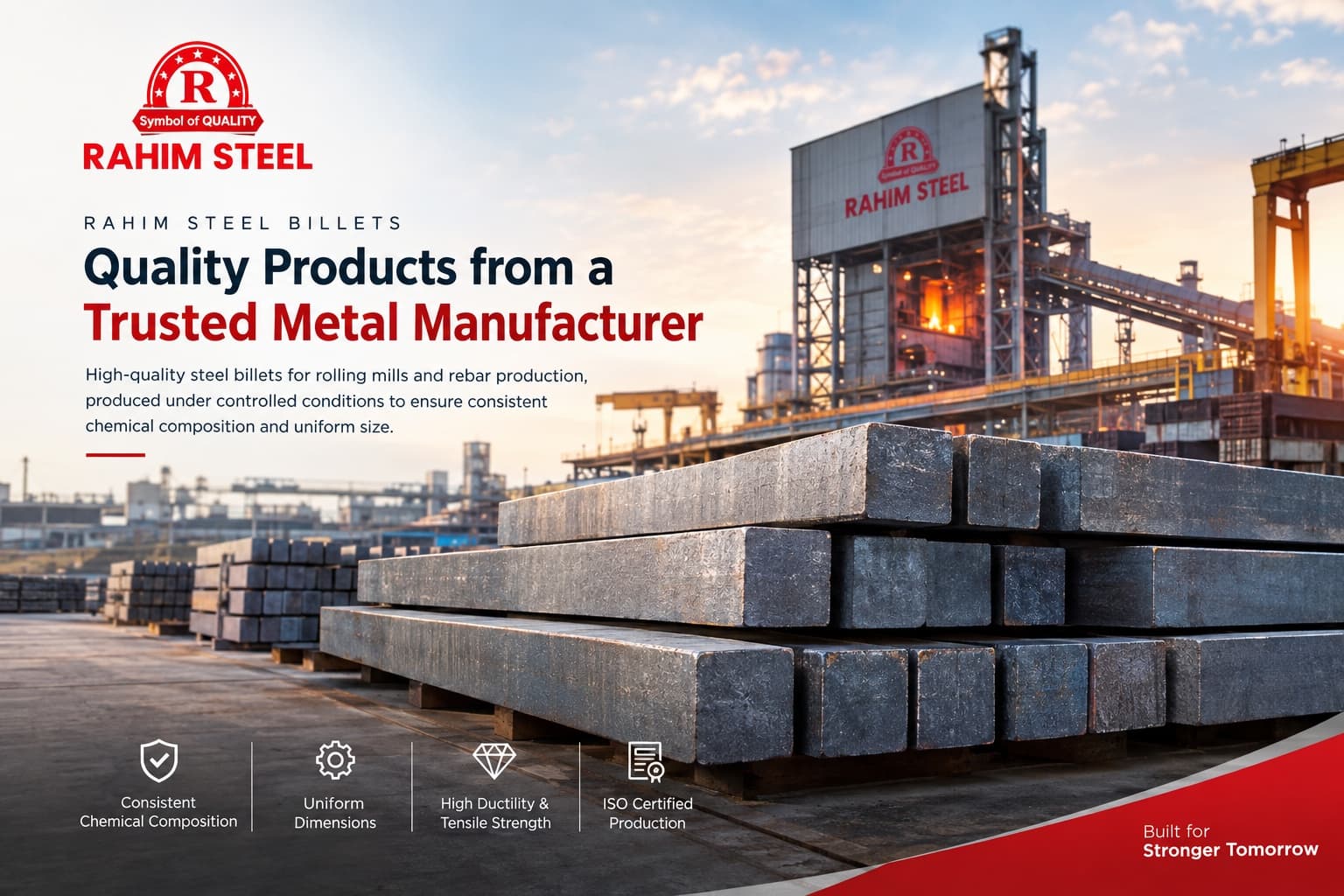
Rahim Steel Billets: Quality Products from a Trusted Metal Manufacturer
Rahim Steel Billets: A Reliable Choice from an Experienced Metal Manufacturer
Steel billets are the starting point for many products used in construction, infrastructure, engineering, and industrial manufacturing. Their chemical composition, dimensions, surface condition, and internal quality can affect the performance of the finished steel product.
This article explains the role of Rahim Steel Billets, how they are manufactured, where they are used, and why consistent billet quality matters to rolling mills and downstream steel producers.
Rahim Steel Billets for Rolling Mills and Steel Production
Rahim Steel Billets are produced as a primary raw material for rolling mills and manufacturers of finished steel products. The billets are manufactured under controlled conditions with attention to chemical composition, dimensions, surface quality, and batch consistency.
The typical material is mild or medium-carbon steel, with the following chemical composition:
- Carbon ©: 0.25–0.35%
- Manganese (Mn): 0.40–1.20%
- Silicon (Si): 0.03–0.50%
- Phosphorus (P): ≤ 0.045%
- Sulfur (S): ≤ 0.050%
The production follows ISO 6935-2:2016 requirements and uses ISO 9001-certified processes.
For a metal manufacturer, billet consistency matters because the raw material goes directly into the rolling process. Variations in chemistry, dimensions, or internal quality can affect production efficiency and the properties of the finished steel.
Key Product Features
Rahim Steel Billets are designed with:
- Controlled chemical composition
- Uniform dimensions
- Clean surface condition
- Consistent mechanical properties
- High ductility
- Good tensile strength
- Reduced internal defects
- Suitability for downstream rolling operations
All products undergo quality testing and are supplied with material certificates.
How Rahim Steel Billets Are Manufactured
Billet production starts with melting and refining steel in an induction furnace. The process is controlled to maintain the required chemical composition and limit unwanted impurities.
Melting and Refining
Steel is melted in an induction furnace. During this stage, the material is monitored to achieve the required chemistry while keeping impurity levels under control.
Ladle Treatment and Deoxidation
After melting, the steel receives further treatment. Elements such as carbon and manganese are adjusted according to the required grade, while deoxidation helps prepare the molten steel for casting.
Continuous Casting
The molten steel is continuously cast into square or rectangular billets. Typical billet sizes range from approximately 100 mm × 100 mm to 150 mm × 150 mm, depending on production requirements.
Cooling and Solidification
Controlled cooling allows the billets to solidify uniformly. This stage is important for maintaining consistent structure, hardness, and dimensional stability.
Cutting and Finishing
Once solidified, the mill cuts billets into standard lengths, typically between 4 & 12 meters. The surfaces are inspected before bundling for shipment.
Quality Control
Each production batch can undergo chemical analysis, dimensional checks, and mechanical testing. These checks help verify that the billets meet the specified production and quality requirements.
For a metal manufacturer, this controlled production process provides the consistency needed for efficient downstream processing.
Applications of Rahim Steel Billets
Steel billets are used across several areas of steel manufacturing. Their main purpose is to provide a suitable starting material for rolling and forming finished steel products.
Common applications include:
- Production of TMT bars and reinforcement steel
- Structural steel production in rolling mills
- Manufacturing of angles, channels, rods, and sections
- Automotive and machinery applications
- Engineering components requiring reliable steel input
- Construction and industrial projects
- Production of other rolled steel products
The quality of the billet can influence rolling performance, production stability, and the properties of the final product. For this reason, manufacturers need raw materials with controlled chemistry and consistent physical characteristics.
Rahim Steel: Experience in Bangladesh’s Steel Industry
Rahim Steel’s history goes back to 1958, when National Foundry was established in Shyampur, Dhaka, producing basic iron and cast products.
Over the following decades, the company expanded its activities in steel production:
- 1958: National Foundry was established in Shyampur, Dhaka.
- 1968: The first re-rolling mill in Bangladesh was launched to manufacture 40-grade deformed bars.
- 1976: Diamond Steel Products Co. Pvt. Ltd. was founded.
- 1983: Rahim Steel Mills Co. (Pvt) Ltd. was established in Kachpur, Sonargaon.
- 1984: Bangladesh’s first steel plant was established.
- 2002: Rahim Energy, a 30 MW power plant, was inaugurated.
- 2003: Production of mild steel commercial plates began.
- 2004: Germanischer Lloyd (GL-A) certification was awarded for shipbuilding-grade plates.
This history gives Rahim Steel a long-standing presence in Bangladesh’s steel manufacturing sector.
Quality, Testing, and Customer Support
Quality control is an important part of billet production. Rahim Steel states that its products undergo quality testing and are supplied with material certificates.
For buyers, documentation can help verify material characteristics and support quality control during downstream production.
Customers looking for billet supply can contact Rahim Steel’s sales team to discuss product specifications, requirements, and quotations.
Conclusion
Steel billets are a basic input for producing many of the steel products used in construction, infrastructure, engineering, and industrial applications. Consistent chemistry, dimensions, and quality control can make a significant difference during the rolling process.
With experience in Bangladesh’s steel industry and a focus on controlled billet production, Rahim Steel provides billets for TMT bars, structural steel, rods, sections, and other downstream applications.
If you are looking for a metal manufacturer for steel billet requirements, reviewing product specifications, quality documentation, and application requirements is a practical first step before placing an order.
Need Steel Experts? Contact Rahim Steel to discuss your billet requirements and request a quotation.
Question & Answer
What are Rahim Steel Billets used for?
Rahim Steel Billets are primarily used as raw material for producing TMT bars, reinforcement steel, rods, structural sections, angles, channels, & other rolled steel products. They can also be used in selected engineering, machinery, & industrial applications.
How are steel billets manufactured?
Steel is melted and refined, then adjusted to the required chemical composition. The molten steel then goes through continuous casting, controlled cooling, cutting, inspection, and quality testing before shipment.
Why is billet quality important?
Consistent chemical composition & dimensions help rolling mills maintain stable production and achieve predictable mechanical properties in finished steel products.
Need Steel Experts?
We have our own team of civil and architectural professionals ready to assist you. Just share your requirements with our experts — we’ll be happy to serve you with the right solutions, exactly as you need.
Contact Our Experts