
Rahim steels Billets: Specifications, Applications and Company History
Rahim Steels Billets: Product Specifications, Applications & Company History
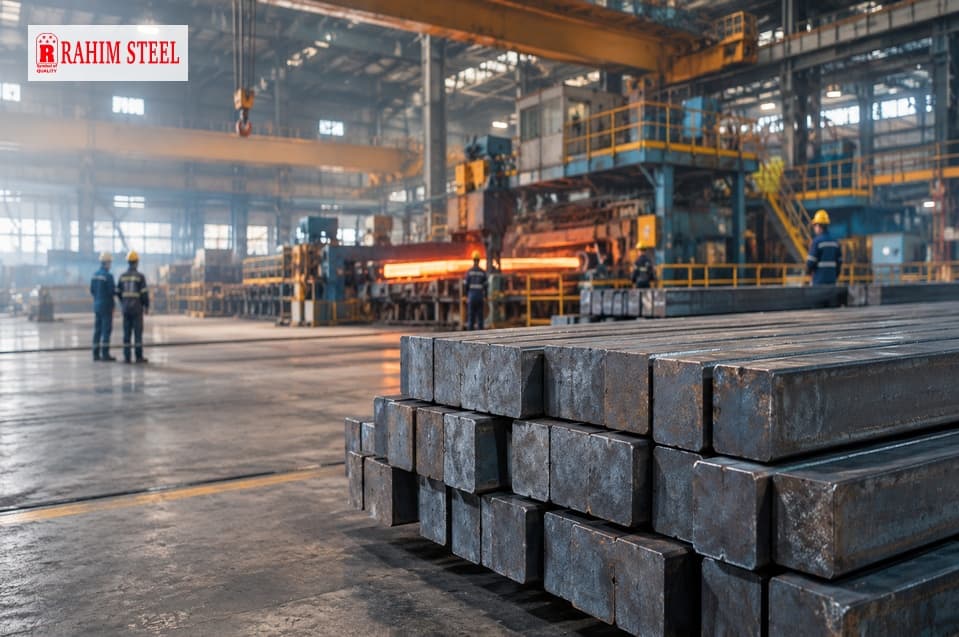
Steel billets are the starting material for many finished steel products, including reinforcing bars, rods, & structural sections. For rolling mills, raw-material quality matters: chemical composition, dimensions, & surface condition all affect how the steel performs during processing.
Rahim Steels manufactures billets for rolling mills & rebar production. Its product information describes controlled manufacturing conditions, uniform dimensions, and batch-level quality testing. This article covers the billets’ specifications, their intended applications, and the company’s development in Bangladesh.
Steel Billets: Specifications, Production & Applications
A billet is a semi-finished steel product that undergoes further processing to become a finished bar, rod, or section. The company’s billets are described as mild- or medium-carbon steel, manufactured through a continuous casting process.
The following figures are typical values supplied in the product information, rather than confirmed specifications for every order:
| Property | Listed specification |
| Steel grade | Mild / medium carbon steel |
| Carbon (C) | 0.25–0.35% |
| Manganese (Mn) | 0.40–1.20% |
| Silicon (Si) | 0.03–0.50% |
| Phosphorus (P) | Maximum 0.045% |
| Sulfur (S) | Maximum 0.050% |
| Cross-section | Typically 100 × 100 mm to 150 × 150 mm |
| Length | Typically 4–12 metres |
Production begins with melting and refining. The molten steel then undergoes composition adjustments and deoxidation before continuous casting. After cooling, the billets are cut, inspected, and prepared for shipment.
According to the supplied product description, quality checks include chemical analysis, dimensional verification, and mechanical testing. Material certificates are also provided. Buyers should confirm the required grade, dimensions, applicable standards and certificate details before placing an order.
The listed applications include:
- TMT bars and reinforcement steel.
- Angles, channels, rods and structural sections.
- Steel components for machinery and engineering applications.
These are downstream uses: the billets require further processing before they become finished construction or engineering products.
Company History and Community Commitment
Founded by Mr. Al-Haj Abdur Rahim, the business traces its origins to National Foundry, established in Shyampur, Dhaka, in 1958 to produce iron and cast products.
The company's history records several stages of expansion:
- 1968: A re-rolling mill began manufacturing 40-grade deformed bars.
- 1976: Diamond Steel Products Co. Pvt. Ltd. was established.
- 1983: Rahim Steel Mills Co. (Pvt) Ltd. was established in Kachpur, Sonargaon.
- 1984: A steel plant was established.
- 2002: Rahim Energy introduced a 30 MW power plant.
- 2003: Production of mild steel commercial plates began.
- 2004: The company reports receiving Germanischer Lloyd GL-A certification for shipbuilding-grade plates.
Beyond production, the company describes employment creation, skills development, workplace safety and community support as areas of commitment. Its stated priorities also include contributions to infrastructure, educational institutions and social welfare programmes.
Questions and Answers About the Billets
Q: What are Rahim Steel's billets used for?
A: They serve as raw material for rolling mills producing reinforcing bars, rods, angles, channels, and other steel sections. Their suitability depends on the required finished product and the ordered billet grade.
Q: Which billet sizes are listed?
A: The supplied description lists typical cross-sections from 100 × 100 mm to 150 × 150 mm and lengths from 4 to 12 metres. Confirm available sizes with the sales team.
Q: Do the billets come with quality documentation?
A: The product information states that material certificates accompany the products. Buyers should request documentation covering the supplied batch and their purchase requirements.
Q: What should a quotation request include?
A: Include the required grade, cross-section, length, quantity, delivery location, and testing or certification requirements. These details give the sales team a clear basis for preparing a quotation.
Q: How can buyers contact the company?
A: Use the company’s contact page to request a quotation or discuss product requirements.
Need Steel Experts?
We have our own team of civil and architectural professionals ready to assist you. Just share your requirements with our experts — we’ll be happy to serve you with the right solutions, exactly as you need.
Contact Our Experts