
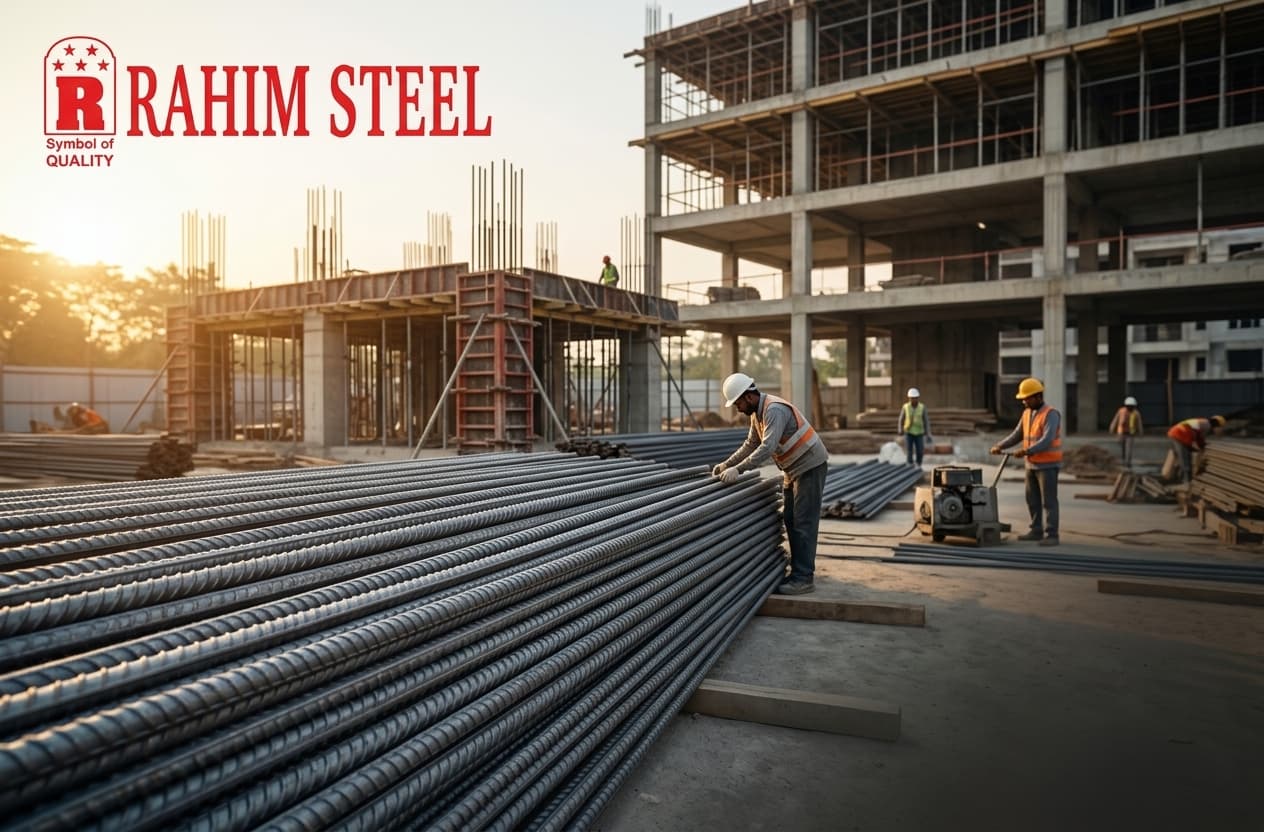
RSM B420DWR Rahim Rod: Strong, Weldable Steel for Safer Buildings
RSM B420DWR: A Reliable Rahim Rod for Stronger and Safer Construction
In modern construction, choosing the right reinforcement steel is essential for structural strength, long-term durability, and safety. RSM B420DWR is a high-performance ribbed reinforcing bar manufactured by Rahim Steel for RCC works, including residential buildings, commercial projects, foundations, columns, beams, slabs, and earthquake-resistant structures.
A quality Rahim Rod helps builders and engineers achieve dependable concrete reinforcement by combining high yield strength, weldability, ductility, & strong bonding with concrete. RSM B420DWR is produced according to BDS ISO 6935-2:2016 and is designed for projects where safety & structural performance matter most.
What Does RSM B420DWR Mean?
The name B420DWR represents the key characteristics of the rebar:
- B means steel for reinforcing concrete.
- 420 indicates a minimum specified upper yield strength of 420 MPa.
- D stands for the ductility class.
- W means the bar is intended for welding.
- R means ribbed bar, designed to bond strongly with concrete.
This designation makes RSM B420DWR suitable for structural applications that require both strength and flexibility. Its ribbed surface helps the steel grip concrete effectively, while the ductile core improves the bar’s capacity to perform under stress, vibration, and dynamic loads.
Key Technical Specifications
| Property | RSM B420DWR Specification |
| Standard | BDS ISO 6935-2:2016 |
| Minimum Yield Strength | ≥ 420 MPa |
| Tensile Strength / Yield Strength Ratio | ≥ 1.25 |
| Minimum Elongation | ≥ 16% |
| Maximum Carbon Content | 0.30% |
| Maximum Manganese Content | 1.50% |
| Maximum Silicon Content | 0.55% |
| Maximum Sulphur Content | 0.040% |
| Maximum Phosphorus Content | 0.040% |
| Maximum Carbon Equivalent Value | 0.56% |
These mechanical and chemical controls are important because they support consistent strength, bendability, and weldability in reinforced-concrete construction.
Why RSM B420DWR Is Suitable for Construction
RSM B420DWR is made through a controlled Thermo-Mechanically Treated, or TMT, process. In this process, hot-rolled steel bars go through three important stages: quenching, self-tempering, and atmospheric cooling.
During quenching, high-pressure water rapidly cools the outer layer of the hot steel bar. This creates a strong external surface. In the self-tempering stage, heat from the inner core moves outward and tempers the surface layer. Finally, atmospheric cooling transforms the core into a more ductile ferrite-pearlite structure.
This combination produces a rebar with a strong outer layer and a flexible inner core. As a result, Rahim Rod B420DWR can deliver a practical balance of strength and ductility for a wide range of RCC applications. Rahim Group states that it hot-rolls its B420DWR rebar from billets and processes it through PLC-controlled online thermo-mechanical treatment.
Main Advantages
- High minimum yield strength of 420 MPa for load-bearing structural elements.
- Minimum TS/YS ratio of 1.25, supporting improved design safety margins.
- Minimum elongation of 16%, helping the bar absorb deformation before failure.
- Better ductility than higher-strength 500-grade alternatives in applications where flexibility is especially important.
- Weldable steel suitable for approved welding, joints, and connection work.
- Ribbed profile that improves bonding between steel and concrete.
- Useful for earthquake-conscious building design because of its ductility.
- Suitable for residential, commercial, and mid-rise RCC structures.
Rahim Group presents Ductility Class “D” as the highest of the four ductility classes under BDS ISO 6935-2:2016. The company also states that the grade meets requirements for earthquake-prone construction and is consistent with key provisions of ASTM A706/A706M low-alloy reinforcing steel.
Applications, Quality, and Rahim Steel Heritage
RSM B420DWR can be used in many types of reinforced concrete work that requires dependable steel reinforcement. Engineers and contractors should always select the bar diameter, spacing, lap length, cover, and reinforcement layout based on approved engineering drawings and applicable building codes.
Common Applications of RSM B420DWR
- Footings and foundations
- RCC columns
- Beams and slabs
- Shear walls
- Residential buildings
- Commercial buildings
- Mid-rise structures
- Infrastructure and public-sector projects
- Earthquake-resistant structural elements
- Projects requiring weldable reinforcement bars
Rahim Steel also produces billets, which are a key raw material for manufacturing TMT bars, rods, and other structural steel products. Properly controlled billet quality supports more consistent downstream rolling performance & finished rebar properties.
A Brief History of Rahim Steel
Rahim Group dates back to 1958, when Late Al-Haj Abdur Rahim established the National Foundry in Shyampur, Dhaka. The group’s first re-rolling mill began manufacturing 40-grade deformed bars in 1968. Rahim Steel Mill was established at Kachpur, Sonargaon, in 1983, followed by the establishment of Bangladesh’s first steel plant there in 1984.
The company later expanded into mild-steel commercial plates, which began production in 2003, and received Germanischer Lloyd approval in 2004 for GL-A-grade hull structural steel plates used in shipbuilding. This industrial history reflects Rahim Steel’s long-standing involvement in Bangladesh’s construction and steel sectors.
Frequently Asked Questions
What is RSM B420DWR?
RSM B420DWR is a ribbed reinforcing steel bar manufactured for concrete reinforcement. “420” indicates a minimum upper yield strength of 420 MPa, “D” indicates ductility class, “W” means weldable, and “R” means ribbed bar.
Is RSM B420DWR suitable for earthquake-resistant structures?
It can suit earthquake-conscious RCC design because it offers ductility, a minimum TS/YS ratio of 1.25, & a minimum elongation of 16%. However, a building's overall earthquake safety depends on the complete structural design, construction quality, detailing, soil conditions, and compliance with BNBC and approved engineering drawings.
What are the major uses of Rahim Rod B420DWR?
It is commonly used in footings, columns, beams, slabs, shear walls, residential buildings, commercial structures, and other RCC works. A qualified structural engineer should make the final selection based on project requirements.
Why is a ribbed bar better for RCC work?
The ribs on the bar increase mechanical bonding with concrete. This reduces the risk of slippage between steel and concrete and helps the reinforcement work effectively within the structural member.
Is B420DWR weldable?
Yes. The “W” in B420DWR indicates that the rebar is intended for welding. Welding procedures, joint design, and on-site practices should still follow the project engineer’s instructions and relevant standards.
What should I check before buying steel rods?
Before purchasing, check the product grade, diameter, manufacturer marking, inspection certificate, relevant standard, physical condition, and supplier reliability. For important construction projects, consult the structural engineer and retain material certificates for quality documentation.
Need Steel Experts?
We have our own team of civil and architectural professionals ready to assist you. Just share your requirements with our experts — we’ll be happy to serve you with the right solutions, exactly as you need.
Contact Our Experts