
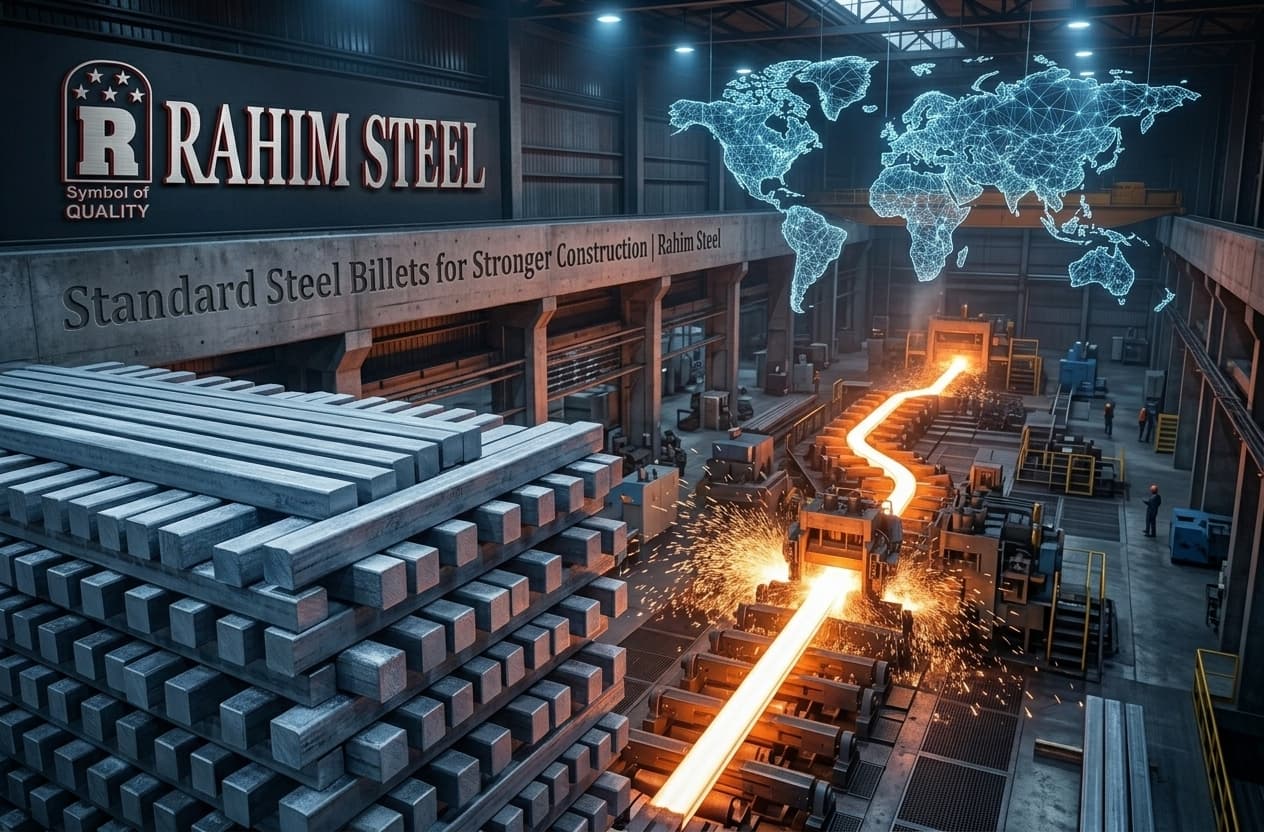
Standard Steel Billets for Stronger Construction | Rahim Steel
Standard Steel: Why Rahim Steel Billets Matter for Quality Construction
Standard steel is the foundation of reliable construction, durable infrastructure, and efficient industrial production. Rahim Steel Billets are manufactured under controlled conditions to support the production of TMT bars, reinforcement steel, structural sections, rods, angles, and channels with dependable quality.
Rahim Steel combines long industry experience with rigorous testing, controlled chemical composition, and consistent billet dimensions. Its billets are designed to help rolling mills achieve stable processing performance and produce finished steel products suitable for demanding construction and engineering applications. Rahim Steel states that its billet, deformed bar, and MS plate production is supported by BUET and ISO 9001 certification and world-class testing facilities.
Standard Steel Begins with Quality Billets
The quality of a finished steel product depends greatly on the quality of its starting material. Steel billets are semi-finished steel sections used as the primary input for rolling mills. They are reheated and rolled into products such as TMT bars, MS rods, structural sections, angles, channels, and other construction materials.
Rahim Steel Billets are made for manufacturers and projects that require uniformity in chemical composition, size, strength, and rolling performance. Produced from high-quality scrap or molten steel through a continuous-casting process, the billets are engineered to have clean surfaces, uniform cross-sections, and minimal internal defects.
Typical specifications for Rahim Steel Billets include:
| Property | Typical Specification |
| Applicable standard | ISO 6935-2:2016 |
| Production quality system | ISO 9001-certified production |
| Steel grade | Mild / medium-carbon steel |
| Carbon | 0.25–0.35% |
| Manganese | 0.40–1.20% |
| Silicon | 0.03–0.50% |
| Phosphorus | ≤ 0.045% |
| Sulfur | ≤ 0.050% |
| Typical billet section | 100 mm × 100 mm to 150 mm × 150 mm |
| Typical length | 4–12 metres |
Balanced levels of carbon, manganese, silicon, phosphorus, and sulfur help support the mechanical behavior of downstream steel products. For example, controlled carbon and manganese levels contribute to strength and ductility, while limiting phosphorus and sulfur helps reduce the risk of unwanted brittleness or processing issues.
How Rahim Steel Produces Standard Steel Billets
High-quality billets require more than melting metal and shaping it into a square section. They require disciplined process control at every stage. Rahim Steel Billets follow a production route designed to create reliable raw material for rolling mills and steel fabricators.
- Melting and refining
- Steel is melted in an induction furnace, where alloying is controlled and impurities are managed to support the required steel grade.
- Ladle treatment and deoxidation
- The molten steel is treated to fine-tune its chemical composition. Carbon, manganese, silicon, and other elements are adjusted to help achieve stable mechanical properties in the finished billet.
- Continuous casting
- The processed molten steel is cast continuously into square or rectangular billet sections. This process supports consistent dimensions and better production efficiency.
- Cooling and solidification
- Billets are cooled in a controlled manner to reduce internal stress, improve structural uniformity, and support consistent hardness across the product.
- Cutting and finishing
- The billets are cut into standard lengths, surface-inspected, and bundled for delivery to rolling mills or industrial customers.
- Quality control and certification
- Each batch can undergo chemical analysis, dimensional checks, and mechanical testing before release. Rahim Steel says its products receive rigorous quality control and are supported by advanced testing facilities for local and international requirements.
This controlled process is what turns molten steel into standard steel that can be trusted for repeatable rolling-mill performance and dependable final products.
Standard Steel Applications in Bangladesh
The demand for standard steel continues to grow as Bangladesh expands its buildings, roads, bridges, industrial facilities, and urban infrastructure. Billets are an essential link in the steel value chain because they become the materials used in many visible and load-bearing products.
Rahim Steel Billets can be used for:
- Manufacturing TMT bars and reinforcement steel for RCC construction.
- Producing MS rods for residential, commercial, and industrial projects.
- Rolling structural steel sections for warehouses, factories, bridges, and fabrication work.
- Manufacturing angles, channels, flats, and other steel sections.
- Supporting automotive, machinery, and engineering applications.
- Providing steel input for rolling mills and steel-processing businesses.
- Supplying foundational steel materials for infrastructure development.
Rahim Steel positions itself as a long-standing participant in Bangladesh’s steel industry, describing more than 60 years of experience and a history connected with the country’s early ship-breaking, steel-plant, and re-rolling operations.
Rahim Steel’s Legacy of Strength
Rahim Steel’s history reflects the industrial development of Bangladesh. Its journey began with National Foundry in Shyampur, Dhaka, in 1958, followed by expansion into re-rolling, steel production, shipbreaking, energy, commercial MS plates, and shipbuilding-grade plate production.
The company’s stated milestones include the launch of Bangladesh’s first re-rolling mill for 40-grade deformed bars in 1968, the establishment of Rahim Steel Mills in Kachpur, Sonargaon, in 1983, and the creation of a major steel plant in 1984. Its later expansion included Rahim Energy, a 30 MW power plant, and commercial mild-steel plate production.
Today, Rahim Steel presents its role as more than steel production. The company emphasizes employment, skills development, workplace safety, sustainable industrial practices, and community engagement. This approach connects industrial growth with the country’s broader social and infrastructure development.
Frequently Asked Questions
What is standard steel?
Standard steel refers to steel produced according to controlled quality requirements for composition, dimensions, strength, and performance. It is important for construction and engineering because it helps ensure that finished products such as TMT bars, rods, and structural sections behave consistently in use.
What are Rahim Steel Billets?
Rahim Steel Billets are semi-finished steel products used as the main raw material for rolling mills. They are processed into TMT bars, reinforcement steel, rods, angles, channels, and structural sections for construction and industrial applications.
Why is billet quality important for TMT bars?
Billet quality affects the strength, ductility, consistency, and rolling performance of TMT bars. Uniform dimensions, controlled chemical composition, and minimal internal defects help rolling mills produce reinforcement bars with more reliable mechanical properties.
Which industries use Rahim Steel Billets?
Rahim Steel Billets are suitable for rolling mills, construction-material manufacturers, structural-steel fabricators, engineering businesses, machinery producers, automotive-related manufacturing, and infrastructure projects.
What quality controls are used for Rahim Steel Billets?
Quality assurance may include chemical analysis, dimensional verification, surface inspection, and mechanical testing. Rahim Steel states that it has world-class testing facilities and holds BUET and ISO 9001 certifications for its billets, deformed bars, and MS plates.
How can I request Rahim Steel Billets?
You can contact Rahim Steel’s sales team through the official contact page to discuss billet specifications, quantities, availability, and your rolling-mill or project requirements.
Need Steel Experts?
We have our own team of civil and architectural professionals ready to assist you. Just share your requirements with our experts — we’ll be happy to serve you with the right solutions, exactly as you need.
Contact Our Experts