
RSM B420DWR
Key Specifications
- Yield Strength (ReH): ≥ 420 MPa
- TS / YS Ratio: ≥ 1.25
- Elongation (minimum): ≥ 16%
- C (max): 0.30%
Quality Assurance
All our products undergo rigorous quality testing and come with material certificates.
Product Overview
The first "B" stands for steel for reinforcing concrete. The next 3 digits represent the specified characteristics value of the minimum upper yield strength. The fifth symbol stands for ductility class. The sixth symbol "W" means intended for welding. The last "R" stands for ribbed bar.
Salient Features of Ductility Class "D":
• According to BDS ISO 6935-2:2016, the highest ductility class is "D" among the four ductility classes. The Elongation at Maximum Force (EMF) is 8% in this class, which is very much effective in earthquake-prone zone.
• The ratio of tensile strength and yield strength (TS/YS) is a minimum of 1.25, which is one of the major requirements of the American Concrete Institute (ACI) and Bangladesh National Building Code (BNBC), especially in earthquake-prone zones.
• Due to its maximum yield strength range, the structural designers will have great flexibility in the yield point (fy) design.
• The major provisions of the Ductility class "D" are complying with Low Alloy Steel Standard: ASTM A706/A706M, which is widely accepted by the structural engineers.
TMT Process
RAHIM STEEL is using the world's prominent latest STS technology to develop Thermo Mechanically Treated (TMT) rebars. The deformed bars are produced in state-of-the-art plants under the close supervision of high-caliber metallurgists and engineers. RSM B420DWR rebars are hot rolled from steel billets and subjected to PLC controlled on line thermo mechanical treatment in three successive stages.
Quenching: The hot-rolled bar leaving the final mill stand is rapidly quenched by high-pressure water in special venturi tubes. This hardens the surface of the bar to a depth optimized for each section through formation of magnetic rim, while the core remains hot and austenitic.
Self Tempering: As the bar leaves the quenching venturi tube the core remains hot compared to the surface, allowing heat to flow from the core to the surface which causes tempering of the outer martensitic layer into a structure called Tempered Martensite. The core still remains austenitic at this stage.
Atmospheric Cooling: This takes place on the cooling bed, where the austenitic core is transformed into a ductile ferrite-pearlite structure. Thus, the final structure consists of an optimum combination of strong outer layer (tempered martensite) with a ductile core (ferrite-pearlite). This gives RSM rebars a unique combination of high strength and ductility.
Customers:
Due to its higher uniform elongation and excellent bend ability, it could be used in all type of RCC structures as well as earthquake-prone zones. It is now widely used in various government projects of PWD, LGED, RHD, DPHE, EED, RAJUK, WASA, City Corporation, MES etc.
Application of RSM B420DWR Rebar:
Suitable for almost all RCC works. Like as
• Footings • Columns
• Beams • Slabs
• Earthquake-resistant structures
• Shear Walls
Advantages of B420DWR:
• Better ductility than 500 grade.
• Safer in Earthquakes.
• Good bond with concrete.
• Weldable.
• Economical for residential & mid-rise buildings.
When RSM B420DWR is Appropriate:
You should use B420DWR when —
* You need strong reinforcement (high yield/tensile strength) for load-bearing or heavy-duty structural elements.
* The structure demands good ductility (e.g., seismic-prone regions, dynamic loads).
* Weldability is required (e.g., for joints, couplers, lap/welded connections)
Technical Specifications
| Property | Value |
|---|---|
| Yield Strength (ReH) | ≥ 420 MPa |
| TS / YS Ratio | ≥ 1.25 |
| Elongation (minimum) | ≥ 16% |
| C (max) | 0.30% |
| Mn (max) | 1.50% |
| Si (max) | 0.55% |
| S (max) | 0.040% |
| P (max) | 0.040% |
| Carbon Equivalent (CEV max) | 0.56 |
| Standard | BDS ISO 6935-2:2016 |
| Ductility Class | D |
| Intended for Welding | Yes (“W”) |
| Ribbed Bar | Yes (“R”) |
Key Features
The “B” in B420DWR denotes steel for reinforcing concrete; “420” indicates a minimum yield strength of 420 MPa.
The “D” stands for the highest ductility class (“D”) under the standard BDS ISO 6935‑2:2016 — meaning the bar is designed with higher elongation/ductility. “W” indicates the grade is suitable for welding.
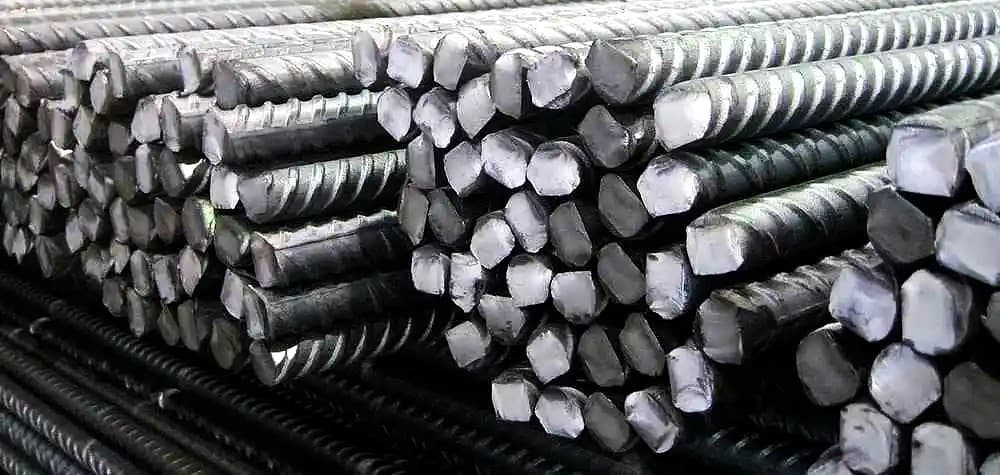
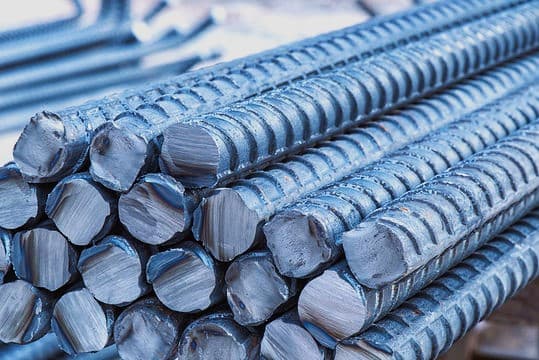
“R” signifies it is a ribbed bar — the ribs enhance bonding with concrete.
Manufactured with a thermo-mechanical treatment (TMT) process
Because of the above process and the high ductility class, this bar is particularly suited for use in earthquake-prone zones and in reinforced concrete (RCC) structures where bending, re-bending and ductility matter.
The high strength and ribbed geometry allow for better bonding to concrete (reducing slip) and improved performance under structural loads.
The weldability (“W”) means that fabricators can perform welding where required (rather than only mechanical splicing), which increases flexibility in construction.
Common diameters available in the market: 8mm, 10mm, 12mm, 16mm, 20mm, 22mm, 25mm, 28mm, 32mm. Standard length 12 meters with Customers cut to length service or special length.
Product Brochure
Download our detailed product brochure for complete technical information.
Download Brochure (PDF)Looking for today's price of RSM B420DWR?
See today's rod price in BangladeshRelated Products
View All ProductsNeed Steel Experts?
We have our own team of civil and architectural professionals ready to assist you. Just share your requirements with our experts — we’ll be happy to serve you with the right solutions, exactly as you need.
Contact Our Experts