
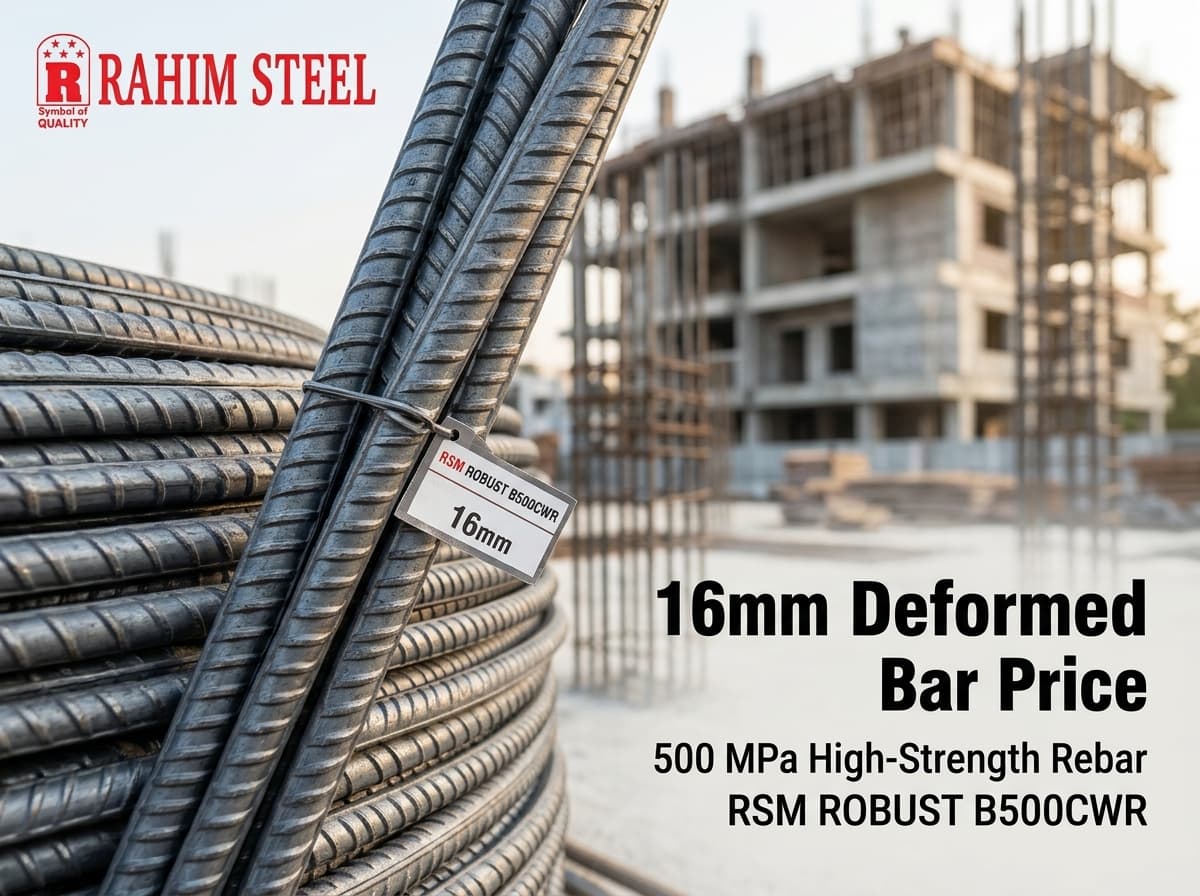
16mm Rebar Price: BD
What to know about 16mm deformed steel bar
Factors to consider when identifying 16mm deformed steel bar pricing include the rebar grade, raw materials, purchase volume, location, and market demand. When building in Bangladesh, consideration should also be given to the overall cost of rebar for a project, as the strength, ductility, and weldability of the steel, as well as its adhesion to concrete, will all impact how much steel is required. Rahim Steel Mills produces RSM ROBUST B500CWR 16mm deformed steel bar, which is a high-strength rebar used in various reinforced concrete building applications such as housing, offices, foundations, bridges, and even earthquake-resistant structures.
16mm deformed steel bar has ridges to improve its adhesion to concrete. The rebar’s grade dictates its strength and ductility and determines which loads it can support. Customers should investigate the rebar’s grade, length, weight, and timescale for delivery. Customers should also seek information regarding testing for the rebar.
16mm Deformed bar pricing – RSM ROBUST B500CWR
Customers should approach Rahim Steel Mills directly to obtain 16mm deformed steel bar pricing for RSM ROBUST B500CWR, as rebar prices can be impacted by numerous variables including raw materials costs, manufacturing processes and volumes, as well as distances for delivery. Rahim Steel Mills offers both rebar pricing and sales assistance via their contact page. Customers can therefore contact them for rebar-related queries, advice, and specific project needs.
RSM ROBUST B500CWR is a weldable, class C, 500 grade deformed steel bar. Within the grade description, ‘B’ denotes that it is for concrete reinforcement; ‘500’ represents the minimum upper yield point. ‘C ’ indicates class C ductility, and ‘W’ shows that it is weldable. Finally, ‘R ’ refers to the rebar being ridged. It has a minimum yield point of 500MPa, a tensile strength-to-yield strength ratio of at least 1.15, a minimum elongation of 7.5%, and a maximum carbon level of 0.24%.
Specification RSM ROBUST B500CWR
Yield Point ≥ 500MPa
TS/YS Ratio ≥ 1.15
Elongation 7.5%
Carbon ≤ 0.24%
Ductility Class C
Weldable Yes
Surface Ridged
These properties are important for 16mm rebar, as it can be used in a range of building elements such as columns, beams, footings, slabs, shear walls, and frames. Higher yield point rebar can allow for reduced steel volumes to support the same load. However, the structural engineer’s design will always need to be adhered to.
Why B500CWR is utilised
B500CWR rebars are well suited for reinforced concrete as they are strong and ductile. Further, the ‘C’ ductility class has been developed to aid in dissipating energy under earthquake loading. As specified for this rebar, elongation at rupture is 7.5%, and there is a tensile strength-to-yield point ratio of at least 1.15. These values correspond to typical expectations for earthquake-resistant reinforced concrete.
The ridged nature of rebar promotes good adhesion between the steel and concrete. This is beneficial as it prevents sliding of the rebar when a structure is subjected to loading. Furthermore, weldability allows for on-site rebar work, provided welding is conducted according to recognised methods and under competent oversight.
RSM ROBUST B500CWR is typically appropriate for;
Housing
Offices
Columns, beams, slabs and frames
Footings, pile heads and mass base slabs
Bridges, culverts and road infrastructure
Earthquake-resistant structures
Weldable rebar applications
Rahim Steel explains that they supply B500CWR rebar for government projects for a variety of relevant departments, including PWD, LGED, RHD, DPHE, EED, RAJUK, WASA, city corporations, and MES. ( rahimsteel.com )
Benefits of the TMT method
RSM ROBUST B500CWR is manufactured using thermo-mechanical treatment (TMT). Immediately after the final rolling operation, the hot-rolled steel bar is at a temperature of around 950-1050oC. It is then rapidly cooled by high-pressure water spraying to develop a hard martensitic outer layer. Meanwhile, the core remains hot.
At this point, the core heat is transferred to the outer layer, and this anneals the hard martensite. Tempered martensite is thereby created, which is both strong and ductile. The rebar is then allowed to cool naturally on a cooling bed.
Throughout this time, the core evolves into a ferrite-pearlite structure, which in turn promotes ductility and workability.
Consequently, the rebar has a firm outer layer and a more workable core. This enables the rebar to be both shaped and endure structural loading effectively, without becoming brittle.
Factors impacting rebar pricing
Whereas pricing for 16mm deformed steel bars will not be identical for all projects and suppliers, it is important to request a current quotation and to examine pertinent contractual information.
Key considerations include;
Rebar grade – Pricing for B500CWR may vary from that of less strong or less ductile rebar grades.
Purchase volume – Volume can also impact pricing due to manufacturing and stock levels.
Location – Delivery, loading, unloading, and site access all contribute to the total delivery cost.
Length and sawing – Bars can often be supplied in standard lengths. Custom sawing may be more costly.
Market factors – Steel price can be influenced by scrap, billet, energy, and currency market values.
Testing and certification – For formal projects, documentation relating to testing and certification of the steel may be necessary.
Contractual conditions – Payment methods (such as upfront or credit payment), alongside delivery timings, can both influence pricing.
To enable the Rahim Steel sales team to accurately formulate a quotation, customers should share details of a project’s location, rebar weight requirement, diameter, grade, length, and anticipated delivery date.
RSM ROBUST B500CWR versus B420DWR
Alongside RSM ROBUST B500CWR, Rahim Steel also produces RSM B420DWR, which is another weldable ridged rebar. The key variance is in the rebar’s grade and hence its ductility. The minimum yield point for B500CWR is 500MPa. In comparison, for B420DWR, this figure is 420MPa.
Feature RSM ROBUST B500CWR RSM B420DWR
Minimum Yield Point 500MPa 420MPa
TS/YS Ratio ≥ 1.15 ≥ 1.25
Minimum Elongation 7.5% 16%
Maximum Carbon Content 0.24% 0.30%
Ductility Class C D
Optimal Application: High-strength structural rebar Applications requiring enhanced ductility and workability
Typically, B500CWR is favoured where increased strength and effective load support are important design considerations. B420DWR could be appropriate where greater ductility is of prime importance. This is particularly so for housing and medium-rise buildings. The most fitting rebar type will depend upon structural drawings, loading considerations, earthquake-resistant requirements, and the structural engineer’s specifications. ( rahimsteel.com )
Quality and Certificates
Rahim Steel claims that they conduct quality testing on their goods and provide certificates for steel. Customers should request a certificate to accompany each rebar delivery. They should also ensure that the grade, diameter, heat number, and test outcomes correspond with those stipulated in a customer’s order.
Rebar should be stored on a raised surface and kept clear of mud and water. Furthermore, care should be taken to avoid damage to ridges. Although visual assessment can provide some indication of steel quality, this should not be the sole method of evaluation. Appropriate rebar storage, handling, and installation methods all contribute towards maintaining rebar performance.
Rather than relying on generic online information, customers should seek a current quotation for 16mm deformed steel bar. Key attributes of RSM ROBUST B500CWR are its high minimum yield point (500MPa), class C ductility, weldability, and ridged surface. As a result, it is highly applicable to a variety of reinforced concrete building applications, such as housing, foundations, infrastructure, and earthquake-resistant structures. Sales and quotation services can again be accessed via Rahim Steel’s contact page for tailored project information and requirements.
Frequently Asked Question
1. What are the price influencing factors for 16mm deformed steel bar?
As previously outlined, rebar pricing can be affected by factors such as grade, volume, location, market values, and sawing needs. Due to differing physical characteristics, the pricing of B500CWR may also differ from that of B420DWR.
2. Is RSM ROBUST B500CWR fit for use in seismically active regions?
Yes. As a class C rebar, B500CWR has good ductility. With a minimum elongation of 7.5% and a tensile strength-to-yield point ratio of at least 1.15, it can aid in energy dissipation under earthquake loading. Nonetheless, confirmation of suitability for such regions should be obtained from a project’s structural engineer.
3. Can 16mm B500CWR rebar be welded?
Yes. The ‘W’ in B500CWR designates that it is weldable. Moreover, the rebar possesses a low carbon equivalent, which further enhances weldability. Nevertheless, welding operations should be undertaken in accordance with recognised techniques and in line with structural design guidelines.
4. In which situations can 16mm deformed steel bar be utilised?
16mm deformed bars can be used in columns, beams, footings, slabs, shear walls, foundations, bridges and structural frames. They are typically applicable to numerous reinforced concrete applications where a 16mm, designated grade rebar is required.
5. How do I obtain precise 16mm deformed steel bar pricing?
Share with Rahim Steel the rebar grade, diameter, volume, length, and location, together with a project timeline. Rahim Steel Mills can then provide a quotation. Again, sales assistance can be accessed via their contact page.
Need Steel Experts?
We have our own team of civil and architectural professionals ready to assist you. Just share your requirements with our experts — we’ll be happy to serve you with the right solutions, exactly as you need.
Contact Our Experts