
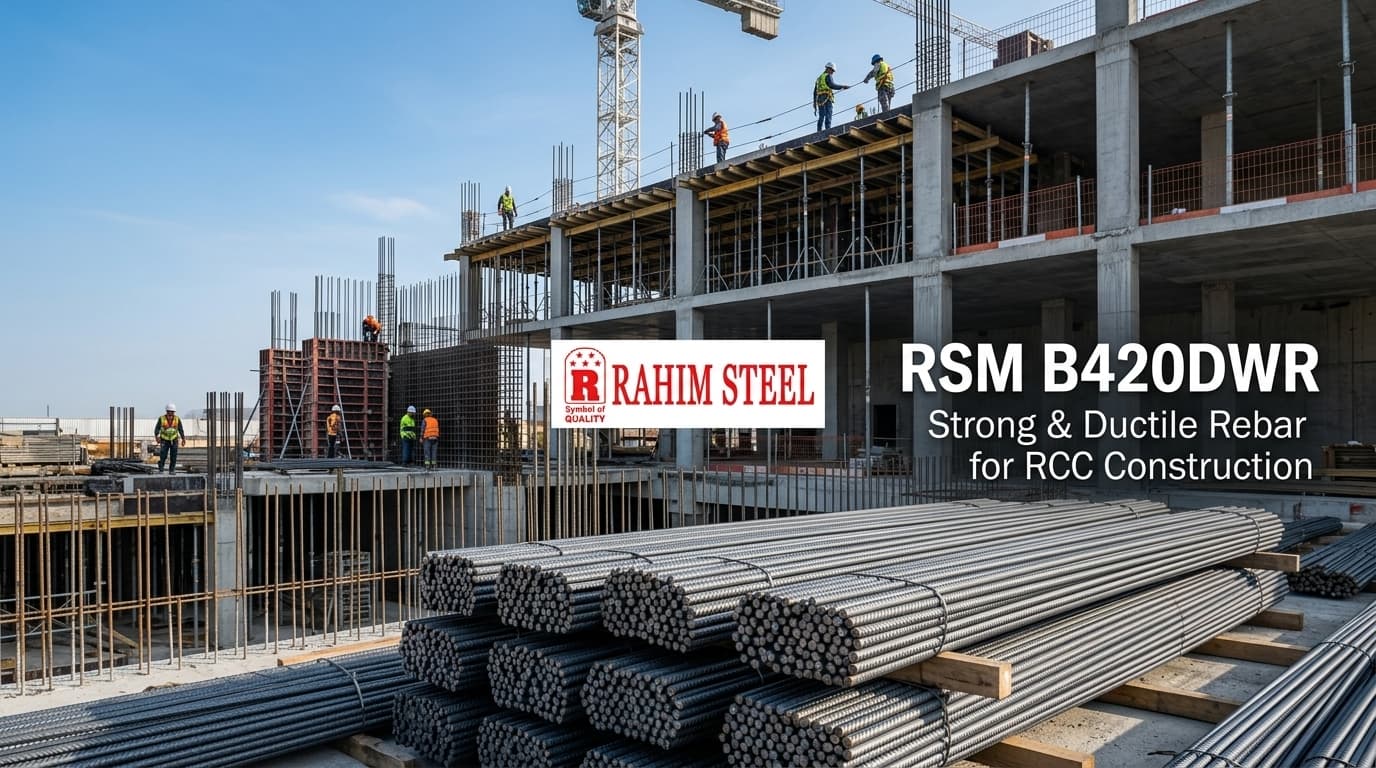
RSM B420DWR: Strong & Ductile Rebar for RCC Construction
RSM B420DWR: A Strong and Ductile Rebar for RCC Construction
A building’s strength and durability do not depend on concrete alone. From the foundation to columns, beams, and slabs, choosing the right reinforcement steel is equally important. For RCC construction, rebar needs to offer a good balance of strength, ductility, bendability, and, where required, weldability.
Rahim Steel’s RSM B420DWR is a Thermo Mechanically Treated (TMT) ribbed rebar designed for different RCC and structural applications. According to the product specifications, it has a minimum yield strength of ≥420 MPa, a TS/YS ratio of ≥1.25, and a minimum elongation of ≥16%.
What Is B420DWR and Where Is It Used in Building Construction?
The name B420DWR represents the key characteristics of the rebar. “B” refers to steel for reinforcing concrete, “420” represents the specified characteristic value of minimum upper yield strength, “D” indicates the ductility class, “W” means weldable, and “R” refers to a ribbed bar.
RSM B420DWR is manufactured through a Thermo Mechanically Treated (TMT) process. According to Rahim Steel’s product information, the hot-rolled bar goes through three successive stages: Quenching, Self-Tempering, and Atmospheric Cooling. This process creates a strong outer layer combined with a more ductile core.
Application in Foundation Work
The foundation is one of the most important parts of a building because it transfers the structural load safely to the ground. Reinforcement steel is used in footings, columns, beams, slabs, and other RCC elements according to the structural design.
RSM B420DWR is listed for applications such as:
Footings
Columns
Beams
Slabs
Shear walls
Earthquake-resistant structures
Various RCC works
For foundation and structural work, the required rebar size, spacing, grade, and quantity should always be determined according to the structural drawing and the specifications provided by a qualified engineer.
Why Consider RSM B420DWR for RCC Construction?
One of the key characteristics of RSM B420DWR is its combination of strength and ductility. According to the product information, it has a yield strength of ≥420 MPa, minimum elongation of ≥16%, and a TS/YS ratio of ≥1.25.
Rahim Steel describes Ductility Class D as its highest ductility class and states that it can be useful for structural applications in earthquake-prone areas.
Key Product Features
High Yield Strength:
With a minimum yield strength of ≥420 MPa, the rebar is designed to provide strong reinforcement for structural applications.
Good Ductility:
Its elongation and ductility characteristics can help provide deformation capacity in structural applications where ductility is important.
Weldable:
The “W” in the designation indicates weldability. However, welding should always follow the project specifications and applicable standards.
Good Concrete Bond:
The ribbed surface is designed to provide effective bonding between the reinforcement and concrete.
TMT Manufacturing Process:
The combination of quenching, self-tempering, and atmospheric cooling helps produce a balance of strength and ductility.
Statement from Rahim Steel
According to Rahim Steel’s published company history, Founder Chairman Mr. Abdur Rahim started Bangladesh’s first professional ship-breaking operation in 1983. The company states that his aim was to help ensure a sustainable supply of raw materials for the country’s steel industry.
Rahim Steel’s history dates back to 1958, when National Foundry was established in Shyampur, Dhaka. Over the years, the company expanded into steel manufacturing and other related industrial activities.
According to the company’s published information, Rahim Steel supplies steel products and raw materials for infrastructure, industrial, and commercial projects while focusing on quality, durability, and reliability.
How to Choose RSM B420DWR for Foundation Work?
Before purchasing rebar for a building project, start with the structural design and reinforcement schedule. Determine the required grade, diameter, quantity, and specifications based on the project requirements.
You can then contact an authorized sales channel to check product availability, material certification, and quotation. According to Rahim Steel’s product information, its products undergo quality testing and are supplied with material certificates.
Simple Steps to Choose the Product
1. Check the Structural Design
Review the engineer’s drawings to determine the reinforcement requirements for the foundation, columns, beams, and slabs.
2. Confirm Grade and Size
Check whether B420DWR is specified for your project and confirm the required rebar diameter with the structural engineer.
3. Calculate the Required Quantity
Determine the required quantity based on the reinforcement schedule and construction plan.
4. Check the Material Certificate
Review the available quality documentation and material certificate before purchasing.
5. Request a Quotation
Contact the relevant sales channel to confirm current product availability and pricing.
Conclusion
Reinforcement quality plays an important role in building construction, from the foundation to columns, beams, and slabs. RSM B420DWR combines strength, ductility, a ribbed profile, and weldability, making it a reinforcement option for a range of RCC applications.
For foundation or earthquake-resistant structural projects, however, the product should not be selected based on the product name alone. The structural design, applicable building codes, required grade, and project specifications should all be checked before making a decision.
For your construction project, confirm the required product specification, review the material certificate, obtain a current quotation, and follow the advice of a qualified structural engineer. The right reinforcement, combined with proper structural design and construction practices, is an important part of building a strong and durable structure.
Frequently Asked Questions
Q1. What does B420DWR mean?
B420DWR is a designation for a ribbed and weldable reinforcing bar with a specified yield strength characteristic value of 420 MPa and a Ductility Class D.
Q2. Where can RSM B420DWR be used?
According to the product information, it can be used for footings, columns, beams, slabs, shear walls, and various RCC structures.
Q3. Can B420DWR be used for building foundations?
It can be used for foundation reinforcement when it is specified as suitable for the project by the structural design. Final selection should be based on the structural engineer’s requirements.
Q4. What is the yield strength of B420DWR?
According to Rahim Steel’s product specification, the minimum yield strength (ReH) is ≥420 MPa.
Q5. Is B420DWR suitable for welding?
The “W” in B420DWR indicates weldability. However, actual welding should be carried out according to the project specification, applicable standards, and appropriate technical guidance.
Need Steel Experts?
We have our own team of civil and architectural professionals ready to assist you. Just share your requirements with our experts — we’ll be happy to serve you with the right solutions, exactly as you need.
Contact Our Experts